
The Art of Perception
How to Truly Read a Tarot Card
What Are You Actually Seeing?
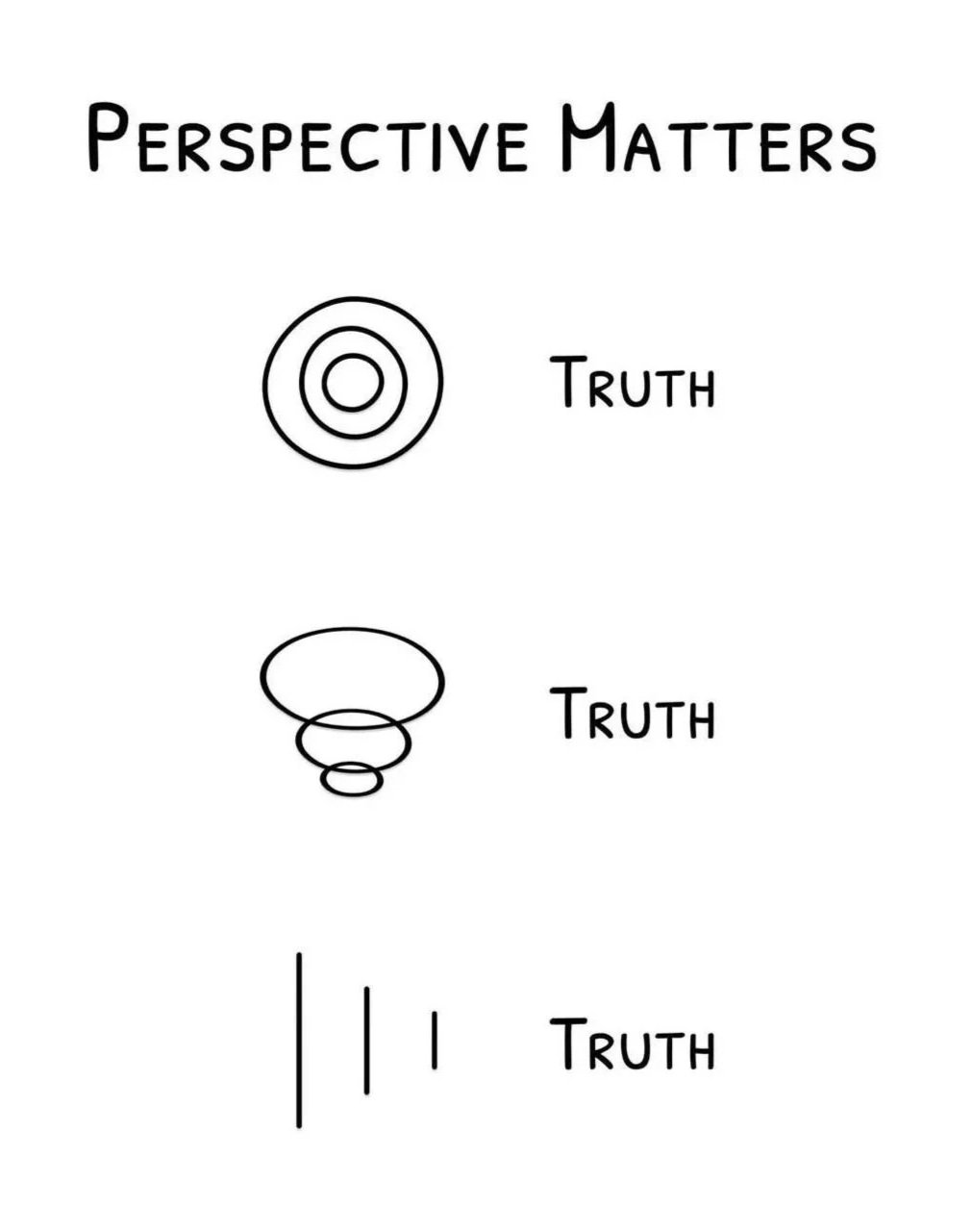
In tarot reading, and in life, the ability to observe before reaching conclusions is essential. Many people move too quickly to interpretation. They see a symbol, a situation, or a behaviour and immediately attach meaning to it. This reaction often comes from habit, learned associations, or personal bias.
True understanding requires something different. It requires the ability to pause, to observe carefully, and to ask a simple question: what am I actually seeing?
Some describe this as perspective or a paradigm shift. It is the capacity to step outside the first explanation that appears and consider that the same situation may hold several possible meanings. This skill is just as valuable in daily life as it is in tarot reading.
Tarot provides a clear example of why this matters. It is very easy to learn that a particular card means a particular thing and then repeat that meaning automatically. However, tarot does not operate through fixed definitions alone. A card never exists in isolation. Its meaning is shaped by the surrounding cards, the imagery within the card, and the context of the situation being explored.
For this reason, observation must always come before interpretation. Perception is a skill.
Learning to Observe the Image
The Five of Swords as a Useful Example
Before deciding what a card means, we must first examine what is actually present within the image.
In this section, I will use the Five of Swords from the Rider–Waite–Smith deck, as the main example. I will also include cards from other decks to highlight how different artists emphasise different aspects of the same card.
Observation requires us to slow down and look carefully at what is actually shown. The figures, their posture, the direction they face, the landscape, the atmosphere, and the emotional tone all contribute to the story being told.
When looking at any card, a few simple questions can guide our attention:
What do we see in the image?
What is absent or missing?
Where is the focus of the image?
What details stand out immediately, and what appears only after closer inspection?
What is their posture or body language?
In which direction are they facing?
Are they interacting with each other, or are they separate?
Is there movement in the image, or does it feel still?
Where does the eye naturally travel first?
What direction do the figures, objects, or landscape guide the viewer’s attention?
What emotional tone does the scene convey?
Does the atmosphere feel calm, tense, chaotic, or reflective?
What colours dominate the image?
Are the colours bright, muted, contrasting, or harmonious?
These are only a few examples of the questions we might ask when learning to observe an image closely.
Like all Fives in the Minor Arcana, the Five of Swords deals with disruption, conflict, and change. Because it belongs to the Suit of Swords, the conflict often operates through the mind and through communication. The element of Air governs this suit and connects it to thought, perception, and language.
The battle shown in this card may therefore be external, internal, or both.
Observation of the Scene
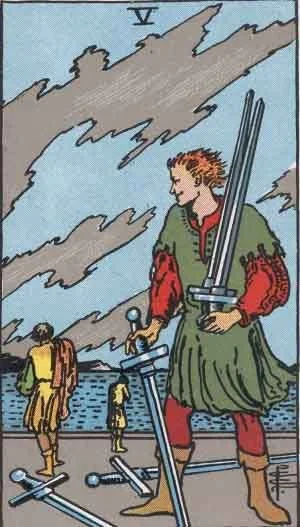
Observation 1 – The Moment After the Conflict
The image appears to show the closing stage of a conflict. In the foreground stands a man holding three swords, while two more swords lie discarded on the ground.
Behind him, one figure walks away with his back turned, while another bends forward in visible distress. The central figure glances back over his shoulder with a faint smile.
At first glance, the scene appears simple: someone has won and others have lost.
Yet careful observation begins to raise questions. What kind of victory is being shown here? The swords have been gathered, but the cost of the conflict is still visible in the posture and movement of the other figures. The scene invites us to consider not only who has gained the upper hand, but also what may have been lost in the process.
Observation 2 – The Victor Who Stands Alone
If the central figure has truly won a battle, why does he stand alone?
Where are his allies? Where are those who supported him in the conflict?
The two other figures do not appear to acknowledge his victory. One walks away, while the other bends over, overwhelmed by the outcome. Rather than witnessing a clear and honourable triumph, we see the aftermath of something more uneasy.
This begins to change the tone of the image. The apparent victory feels less certain when viewed in the context of the whole scene. What first appears as success may instead suggest isolation, resentment, or a victory gained at a cost that cannot be ignored.
Observation 3 – The Atmosphere of the Landscape
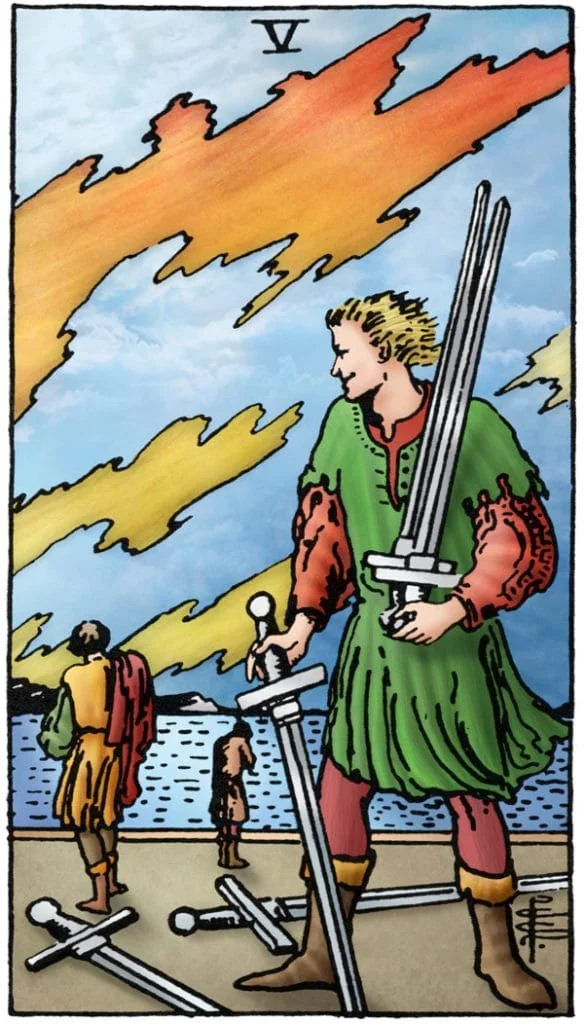
The sky above is harsh and unsettled. Strong winds push jagged clouds across the scene, creating a tense and uneasy atmosphere.
In the distance, mountains rise on the horizon, suggesting further challenges yet to come. Yet between the figures and those mountains lies a large body of water.
The two figures move toward that water, while the central figure remains on solid ground, though his body also turns in the same direction. Before any progress can be made, the divide represented by that water must first be crossed.
This contrast may reflect different psychological responses to the conflict. The retreating figures move toward the water, a symbol often associated with emotion and the unconscious, as if withdrawing inward after the experience of defeat. The central figure, although still on land, also turns toward the water, suggesting that the emotional consequences of the conflict cannot be avoided.
The landscape mirrors the psychological state of the scene: the conflict may have ended, but resolution has not yet been reached. Something still separates the figures from whatever comes next.
Observation 4 – The Swords Themselves
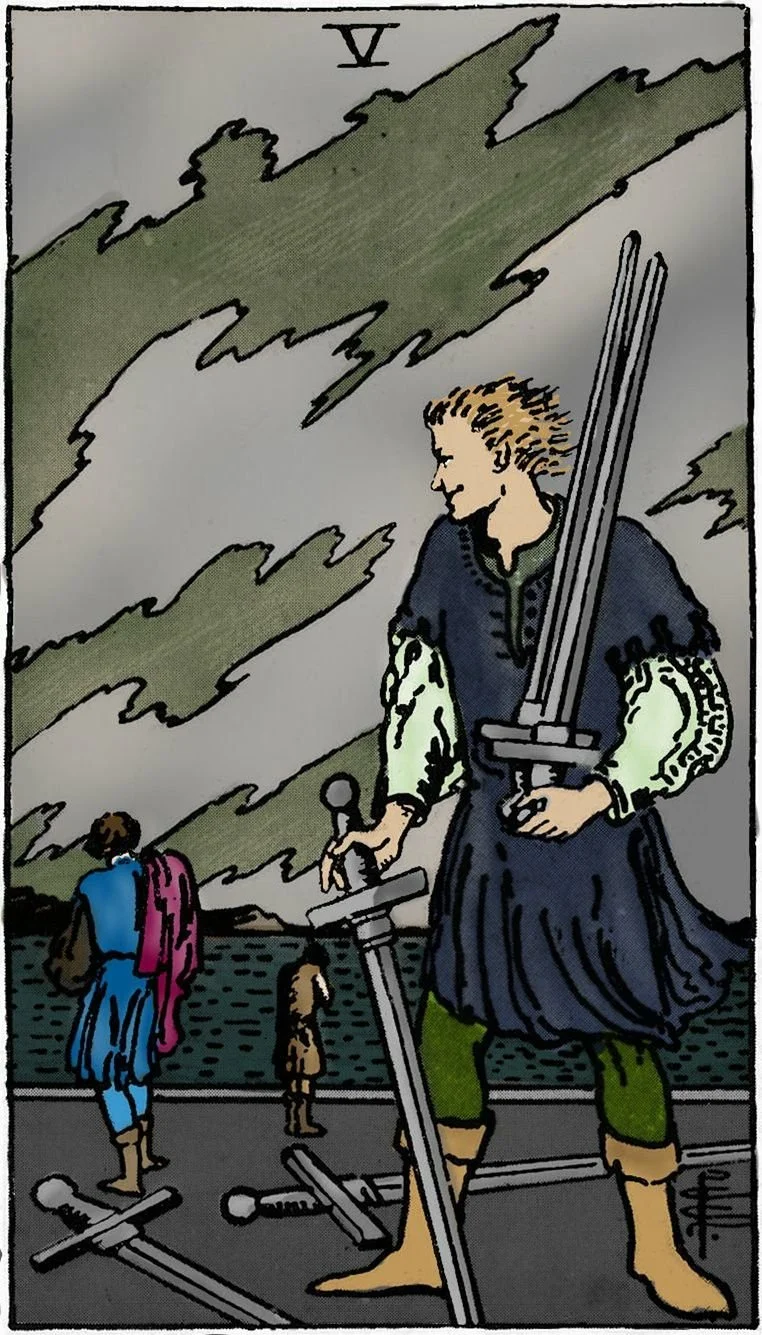
The downward sword recalls the symbolism of the Ace of Swords, often associated with clarity, judgement, and the ability to cut through confusion. In this context it may suggest a decisive mental act, a moment in which something is separated, exposed, or brought to an end.
The two swords in the other hand introduce the symbolism of the number two: duality, choice, and relationship. Two can represent the potential for balance, but also tension between opposing sides.
Seen together, the arrangement suggests a decision imposed through mental dominance. The figure holds the instruments of victory, yet the separation between the swords hints at a lack of true integration. Psychologically, the mind may have won the conflict, but the deeper consequences remain unresolved.
Two swords lie abandoned on the ground. Three remain in the hands of the central figure.
This immediately raises questions. Did he take these swords from the others by force? Were they surrendered? Or did the other figures lay down their weapons because the conflict was no longer worth continuing?
The image does not give a clear answer. Instead, it leaves the outcome open to interpretation. The scattered swords suggest that the most intense moment of the conflict has already passed, leaving behind its visible consequences. What remains uncertain is whether the outcome was determined through strength, strategy, or simple exhaustion.
The imbalance of swords shifts the power within the scene. Control is now concentrated in the hands of a single figure, while the discarded weapons remind us that this victory exists alongside the loss experienced by others.
The way the swords are held adds another layer of meaning. Two are raised in the left hand, pointing upward, while a single sword is held separately in the right hand, angled downward.
Possible Interpretations
Interpretation 1 – Victory Without Honour

From one perspective, the man in the foreground appears triumphant. He holds the weapons and stands as the apparent victor.
Yet the expression on his face may also suggest arrogance or cruelty. If this victory was achieved through manipulation, intimidation, or dishonourable tactics, then the meaning shifts. He may have won the battle, but the cost is clear.
He stands victorious, but he stands alone.
Respect, trust, and loyalty may have been lost along the way. The image invites us to question the nature of victory itself. Not every triumph brings resolution, and some victories leave behind consequences that are harder to repair than the conflict that created them.
Interpretation 2 – The Question of Surrender or Withdrawal
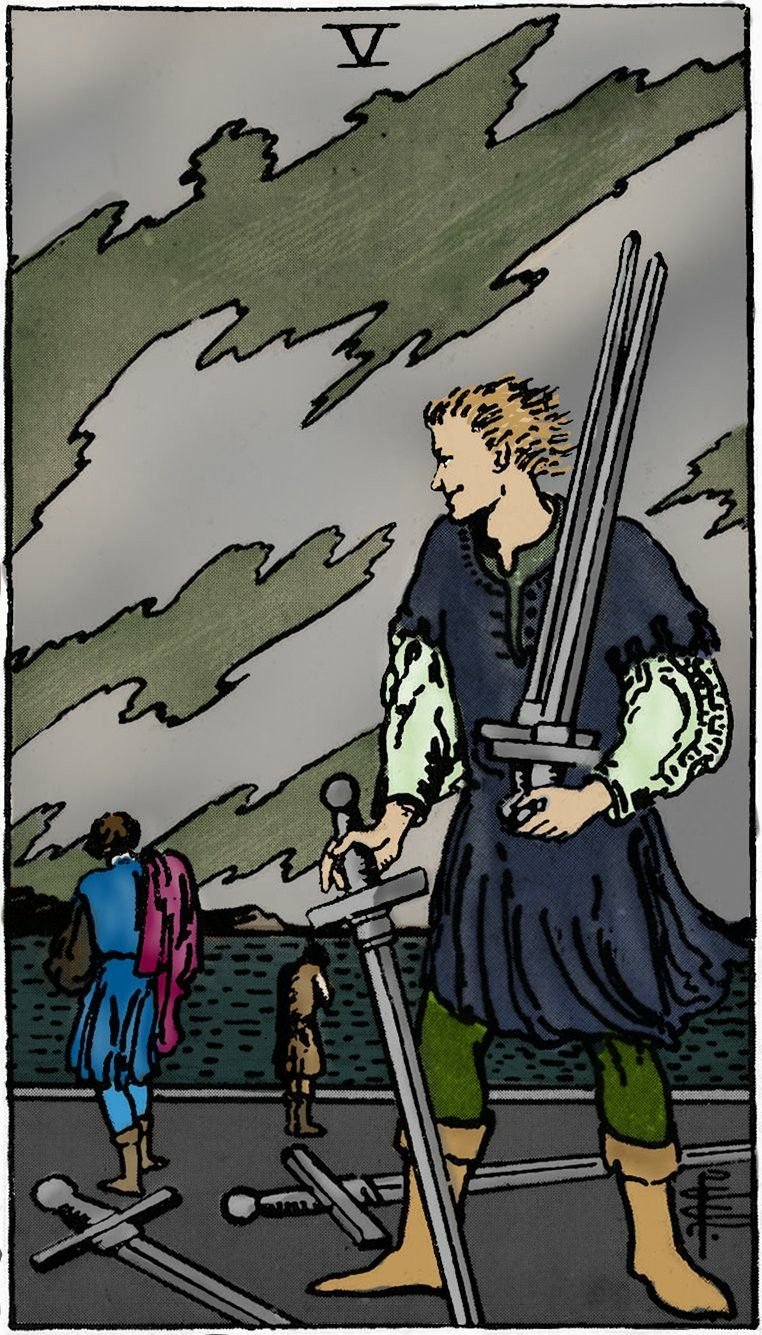
Two swords lie abandoned on the ground. Three remain in the hands of the central figure.
This raises further questions.
Did he take these swords from the others by force? Were they surrendered? Or did the other figures choose to lay down their weapons because the battle was no longer worth fighting?
The image does not give a direct answer. Instead, it invites interpretation. The abandoned swords suggest that the conflict has already reached its conclusion, but the reasons behind that outcome remain unclear. The scene allows us to consider whether the battle ended through defeat, exhaustion, or a conscious decision to step away.
In this sense, the card may also reflect the moment when someone realises that continuing the struggle would bring no meaningful resolution. Walking away does not always mean weakness; sometimes it reflects a recognition that the cost of further conflict outweighs the value of victory.
Interpretation 3 – Reclaiming Personal Power
The Five of Swords therefore raises an important question: when is conflict destructive, and when is it necessary for self-respect?
The card also reminds us that reclaiming power may come at a price. Even when a boundary is justified, relationships and dynamics may change. What matters is not simply winning the conflict, but understanding what the conflict revealed and what it has changed.
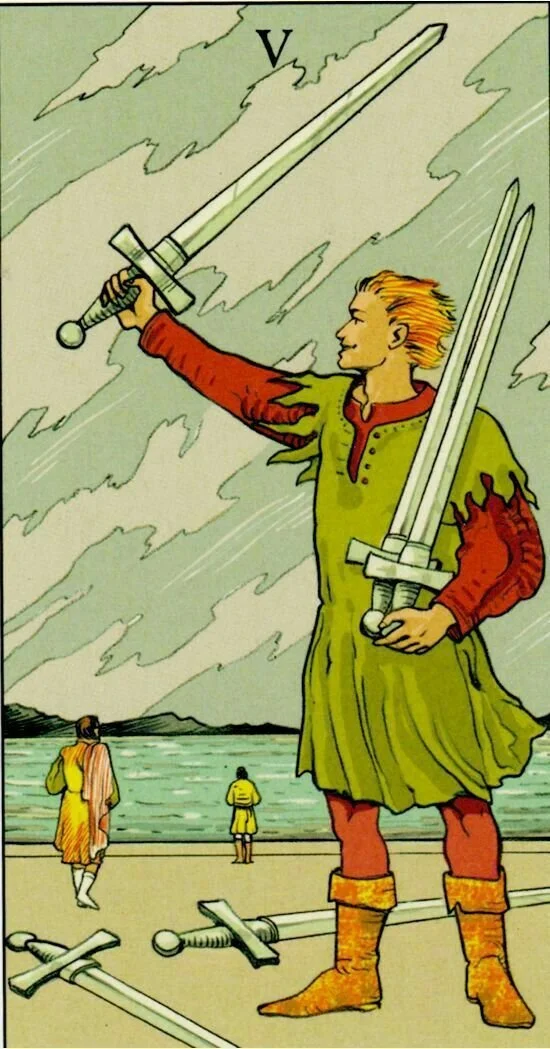
The Five of Swords can also be viewed from another perspective. Rather than focusing only on loss or manipulation, the image may reflect the moment when someone decides to reclaim their personal power.
The central figure stands holding the swords, suggesting that control has shifted. What may once have been a situation of imbalance has now been confronted. He lifts the swords and looks toward them, as if examining the outcome of the conflict. In this moment, the card may show not only victory, but also awareness of what has taken place.
Reclaiming personal power often involves conflict. It may require setting boundaries, refusing unfair treatment, or standing up to someone who previously held the advantage. In this sense, “fighting back” is not simply aggression, but a refusal to remain in a position of defeat.However, such moments rarely leave everyone satisfied.
As the card shows, others may withdraw or walk away once the balance of power changes. What appears as victory from one perspective may be experienced as loss from another.
Interpretation 4– An Inner Psychological Battle
There is also a quieter possibility hidden within the image.
The entire battle may take place within the mind.
The scattered swords and retreating figures can represent conflicting thoughts, self-doubt, or harsh inner criticism. The figure holding the swords may symbolise the moment when a person begins to confront these internal conflicts and regain authority over their own thinking.
From a Jungian perspective, the scene may reflect a confrontation with aspects of the shadow. The retreating figures can represent rejected or disowned parts of the psyche, while the central figure may embody the ego attempting to assert control. What appears to be a conflict with others may therefore reflect an inner struggle between conscious identity and the parts of ourselves we find difficult to face.
In this sense, the Five of Swords can symbolise a difficult psychological victory. The ego may temporarily gain control, but the image also reminds us that integration of the shadow requires more than domination. True resolution emerges not from suppressing these inner forces, but from recognising and understanding them.
What We See Depends on How We Look
Tarot cards do not carry a single fixed meaning. Their imagery is symbolic and open to interpretation, which means the same card can reveal different insights depending on the context, the reader, and the questions being asked. While traditional meanings provide a useful framework, tarot also invites intuitive and symbolic exploration.
For this reason, I absolutely love approaching the cards with curiosity and flexibility. Rather than treating their meanings as rigid definitions, I like to explore how the imagery can speak in different ways. Each observation can open a new layer of understanding, especially when we allow the symbolism to interact with our own experience and reflection.
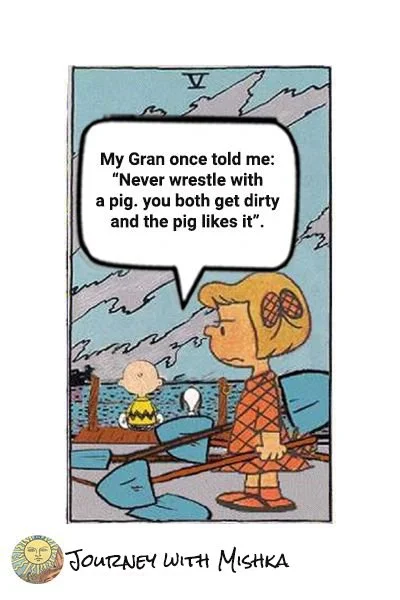
What follows is one possible interpretation of the Five of Swords, inspired both by the symbolism of the card and by a simple piece of wisdom that was passed on to me by my grandmother.
Her advice was straightforward: if someone behaves badly, you do not have to meet them at the same level. Responding in the same way often gives the other person exactly what they want. Sometimes the wiser choice is to step away from the conflict altogether.
In many situations, our presence, attention, and energy are far more valuable than we realise. Choosing not to engage can be a powerful decision in itself. If someone cannot respect or appreciate that presence, it may be wiser to remove yourself from the situation.
Find out more: The Five of Swords —Knowing When to Walk Away
When We Learn to See
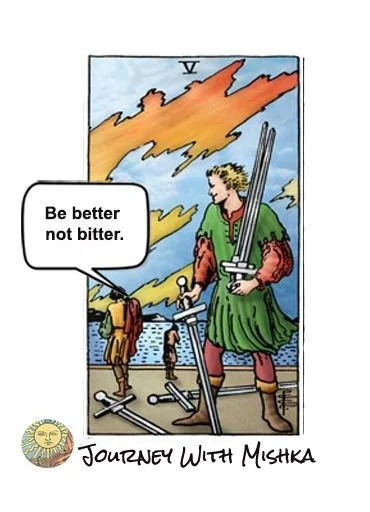
Tarot cards are inherently multi-layered. Each card can be understood as part of a broader symbolic category, almost like an archetype, a reservoir of possible meanings rather than a single definition. The imagery therefore opens a range of interpretations that may unfold depending on the situation, the reader, and the question being asked.
Traditional meanings provide a useful framework, but tarot also invites intuitive and symbolic exploration. The images function as a symbolic language that encourages observation, reflection, and interpretation.
Each reader approaches the cards through their own experience and awareness. In this sense, the reader becomes a conduit through which meaning emerges. The cards offer structure through imagery and symbolism, but interpretation remains flexible.
Tarot is therefore not about memorising rigid definitions. It is about learning to observe carefully and recognise patterns as meaning develops through the interaction between the image, the situation, and the person interpreting it.
Nothing in the card itself changes, what changes is the way we observe it.
This is why perception matters. Tarot is a practice of careful observation and thoughtful interpretation. When we slow down, question our first assumptions, and allow the imagery to speak more fully, the cards reveal far more than a single definition ever could.
The same principle extends beyond tarot. What we see in life often depends on how we choose to look. When we learn to observe before concluding, understanding deepens and meaning expands.