
Tarot de Marseilles
Symbolic Meaning of Colours
Blue in the Tarot de Marseille
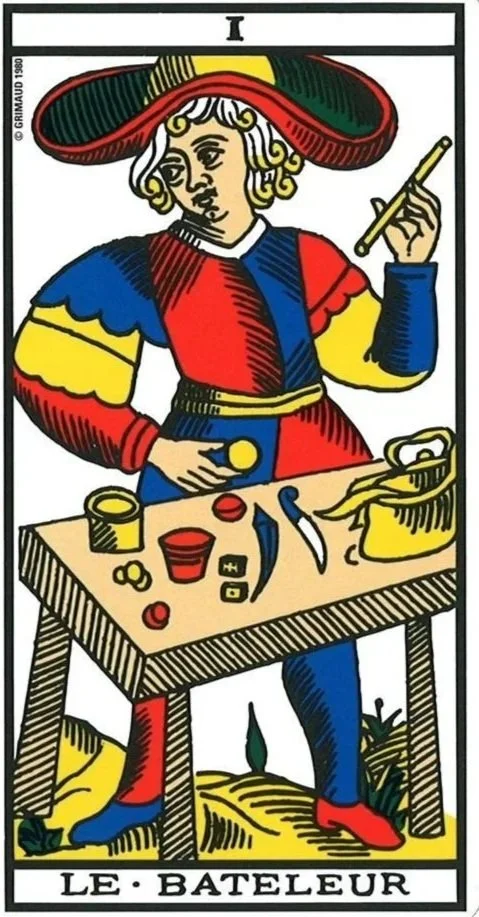
Blue represents spiritual power. It is deep, strong, pure, passive, and immaterial. It is the colour of cosmic emptiness, the sky, night, dreams, sleep, and the unconscious. It symbolises infinity, spirituality, noble aspirations, eternity, purity, emotional sensitivity, and receptiveness. It can also represent depression or escape into an unreal world. These two meanings do not contradict each other, because spiritual searching is often awakened by unrest arising from the unconscious.
In the symbolic language of the Tarot de Marseille, blue represents the spiritual dimension that surrounds and guides human life. It is the colour of contemplation, intuition, and inner awareness. Where red expresses life force and action, blue represents the receptive principle that contains and directs that energy.
For this reason, blue often appears in the garments of figures associated with wisdom, spiritual authority, or inner knowledge. It indicates reflection, depth of perception, and the capacity to receive insight from beyond ordinary awareness.
In the Hermetic interpretation developed by Éliphas Lévi, colours are not decorative but symbolic expressions of universal principles. Blue corresponds to the realm of spirit and the infinite. It represents the inner space in which thought, imagination, and spiritual perception arise.
At the same time, blue reflects the mysterious depth of the unconscious. Turning inward in search of meaning can sometimes appear as withdrawal or melancholy. However, in Hermetic philosophy this inward movement is often the beginning of spiritual awakening. Blue therefore expresses both contemplation and transcendence. It symbolises the silent inner field where human consciousness opens to higher knowledge and spiritual insight.
Red in the Tarot de Marseille
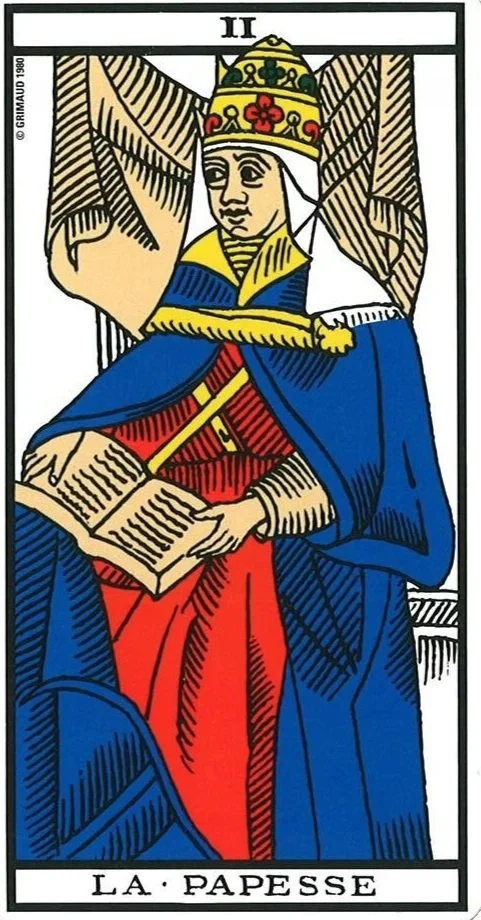
Red represents vital force. It is vibrant, hot, dynamic, and active. It expresses life itself, like fire or blood pulsing through the veins. In the symbolic language of the Tarot de Marseille, red embodies movement, passion, desire, and the powerful energy that animates human life.
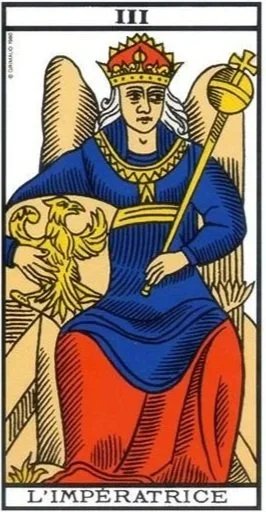
Because this energy is instinctive and intense, it often needs to be guided. For this reason, red frequently appears beneath blue garments in the imagery of the Tarot de Marseille, as seen in figures such as the Empress or the High Priestess. In this relationship, blue symbolises spiritual awareness and inner wisdom, while red represents the vital force that must be contained and directed.
When this energy is not moderated, red may signal danger, injury, blind passion, anger, or uncontrolled power. It can indicate moments when instinct and emotion override reflection and balance.
Dark red carries a deeper and more hidden meaning. Associated with night and secrecy, it suggests mystery, intensity, and the forces that operate beneath conscious awareness. It is connected with the heart, desire, libido, and the inner impulses that move human life.
In its symbolic sense, dark red also represents transformation through symbolic death. It marks the moment when powerful life energy descends into depth, dissolving old forms so that renewal and change can occur. In this way, red represents not only vitality and passion, but also the intense inner forces that drive transformation and rebirth.
Green in the Tarot de Marseille
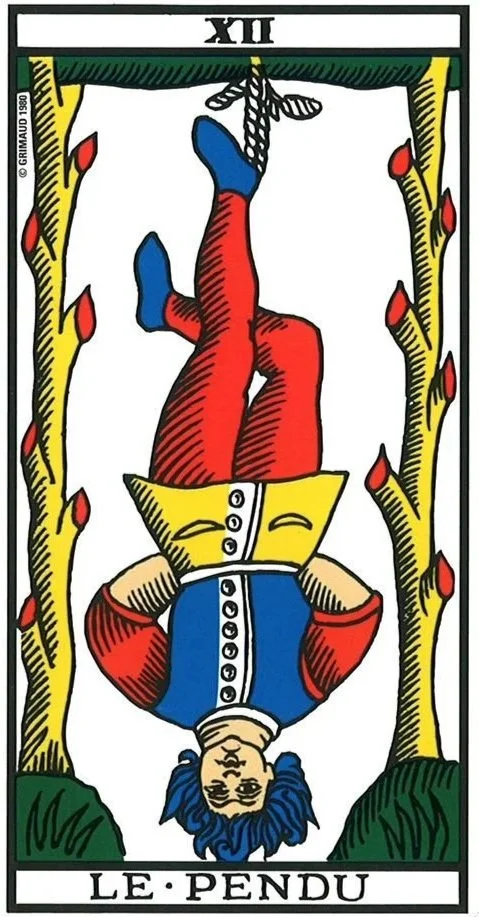
Green is calming, strengthening, and refreshing. Above all, it is an earthly colour. It is the colour of plant life, the primordial waters, and the maternal womb of nature, symbolising growth, nourishment, and the sustaining forces of the natural world.
Green is created by mixing blue with yellow. In symbolic terms this union brings together the spiritual depth of blue and the vital warmth of yellow, producing the living energy that allows life to grow and unfold.
For this reason, green represents the expansive power of nature, the deep forces that move through the earth, and the steady ripening of plants and living forms.
Green is also associated with renewal and regeneration. Like trees that shed their leaves and grow again, it reflects the continuous cycle of growth, decline, and rebirth that governs both nature and human life. It therefore symbolises endurance, patience, and the quiet processes through which life restores itself.
Because it contains qualities linked with youth, vitality, and natural harmony, green is essential for maintaining inner balance. It reminds the observer of the importance of remaining connected to the rhythms of nature, where growth occurs gradually and in accordance with deeper natural laws.
Yellow in the Tarot de Marseille
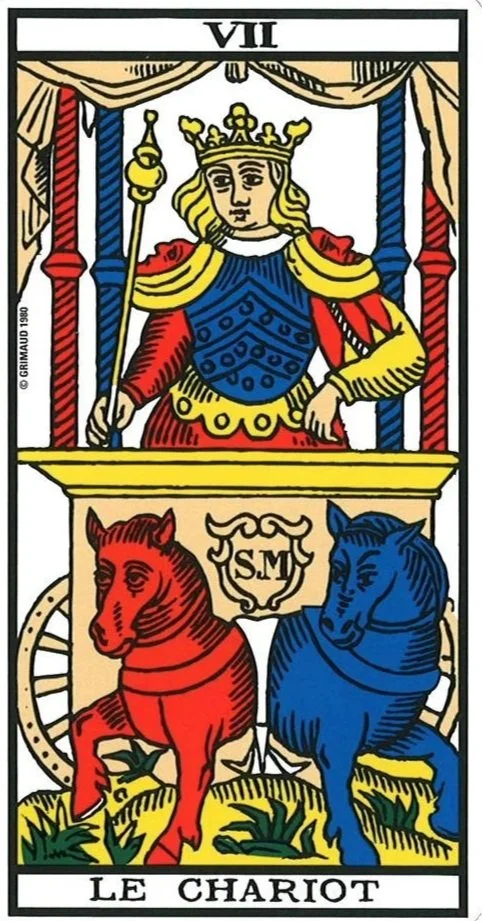
Yellow is warm, expansive, radiant, and sometimes dazzling. It is the colour of gold, the sun, light, ripe grain, honey, and mental power. In the symbolic language of the Tarot de Marseille, yellow represents illumination, clarity, and the awakening of consciousness.
Gold, which belongs to the same symbolic family as yellow, has long represented eternal life and the divine essence. For this reason it is traditionally used to depict the attributes of solar deities, as well as sacred objects such as crosses, chalices, and the halos of saints. In tarot imagery this luminous colour often indicates the presence of divine light or higher understanding.
Yellow therefore expresses intelligence, perception, and the power of the mind to recognise truth. It suggests a moment when something becomes visible or understandable, as if illuminated by sunlight. In many Tarot de Marseille cards, yellow backgrounds or elements signify clarity of awareness and the presence of conscious understanding.
This colour also emphasises the role of the mind in interpreting experience and giving meaning to events. It reflects the capacity for discernment, insight, and the ability to see beyond confusion or illusion.
At the same time, yellow symbolises maturation and transformation. Just as grain ripens under the sun, this colour represents the process through which effort, experience, and awareness gradually lead to completion, both in material life and in spiritual development.
Pink in the Tarot de Marseille
In the Tarot de Marseille, pink appears as a pale flesh tone softened by a strong addition of white. It represents the human condition itself, standing between the instinctive world of the body and the higher aspiration toward the divine. In this sense, pink symbolises the human being gradually moving away from purely animal nature and toward spiritual awareness.
This soft colour gives the elements of an image a subtle spiritual dimension. It suggests life that is conscious, sensitive, and capable of transformation. Pink therefore reflects the living presence of the human being within the symbolic world of the tarot.
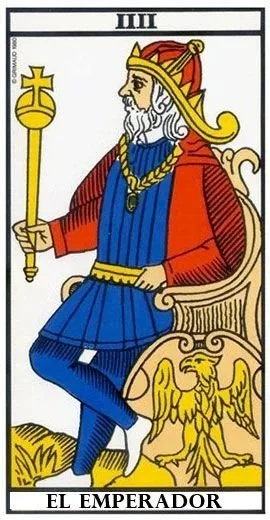
All pink elements are understood as living forms. They symbolise structures composed of living cells that grow, multiply, decay, and are reborn again. This symbolism applies whether the colour appears in the throne of the Empress, the table of the Magician, the Tower of Arcana XVI, or the hermaphrodite figure in the card of the World.
Within the Tarot de Marseille, pink often marks objects created by human hands or closely connected to human life. It reminds the observer that these forms are not inert or fixed, but part of the living process of growth, decay, and renewal.
In this way, pink expresses the fragile yet dynamic nature of human existence. It symbolises the living body as a vessel of transformation, constantly changing while moving between the earthly and the spiritual dimensions.
White in the Tarot de Marseille
White is the colour of transition and initiation. It is traditionally associated with those who are about to pass from one state of life into another: individuals preparing for communion, novices entering religious life, people entering marriage, and even those approaching death. In this sense, white symbolises the threshold between two conditions, marking a moment of passage and transformation.
In the symbolic language of the Tarot de Marseille, white represents a state of purity and openness. It indicates a condition in which something new is about to begin, but has not yet fully taken form. It is therefore the colour of beginnings, preparation, and potential.
White is also connected with dawn, birth, innocence, virginity, and fragility. These associations reflect a moment that is delicate and temporary, when a person stands at the edge of change. It suggests a state in which the future remains unwritten.
As a pure, neutral, and passive colour, white indicates that nothing has yet been completed or determined. It symbolises a blank state in which possibilities exist but have not yet manifested.
Within the imagery of the Tarot de Marseille, white often appears in garments, objects, or spaces that signal readiness for transformation. It prepares the individual for the symbolic ceremony of change, marking the moment before a new stage of life begins.
Black in the Tarot de Marseille
Black is the colour of night, death, widowhood, abyssal depths, mist, caves, and the unconscious. It represents the hidden and unknown dimensions of existence, where forms dissolve and visibility disappears. In the symbolic language of the Tarot de Marseille, black often marks what lies beyond ordinary perception and conscious understanding.
This colour is closely connected with the mysterious depths of the psyche. It evokes the inner regions where instinct, memory, and unconscious forces reside. For this reason, black can symbolise fear, uncertainty, or the experience of confronting what is hidden within oneself.
At the same time, black does not represent only absence or destruction. In many symbolic traditions it also refers to the fertile darkness from which life emerges. The rich black soil of ancient Egypt, nourished by the Nile, was a symbol of fertility and renewal, reminding us that life often begins in darkness.
Within the imagery of the Tarot de Marseille, black therefore carries a dual meaning. It can indicate the end of a cycle, dissolution, or the unknown, but it can also represent the fertile ground from which transformation and regeneration arise.
Black may also symbolise the stage of inner withdrawal that precedes change. Just as seeds develop in the darkness of the earth before emerging into light, transformation often begins in hidden or silent processes. In tarot symbolism this colour can therefore represent incubation, introspection, and the gathering of unseen forces before renewal. It reminds the observer that darkness is not only an ending, but also the beginning of a new cycle of growth.
Practical Interpretation of Colours
In the Tarot de Marseille, colours are not decorative details. They function as symbolic indicators that reveal the nature of the energy present in a card. Observing the colours carefully helps to understand whether a situation is driven by instinct, reflection, transformation, or spiritual awareness.
When interpreting a card, colours should be read as qualities of energy rather than fixed meanings. They describe the tone of the situation and the level of consciousness at which it operates.
When reading the Tarot de Marseille, it is helpful to observe how colours interact with one another. For example, the combination of blue and red may show the relationship between awareness and instinct, while yellow appearing beside darker colours may indicate that clarity is emerging from confusion.
By paying attention to colour relationships rather than isolated meanings, the reader can better understand the balance of forces present in the card and the stage of development that the situation represents.