
What is Hero Journey?
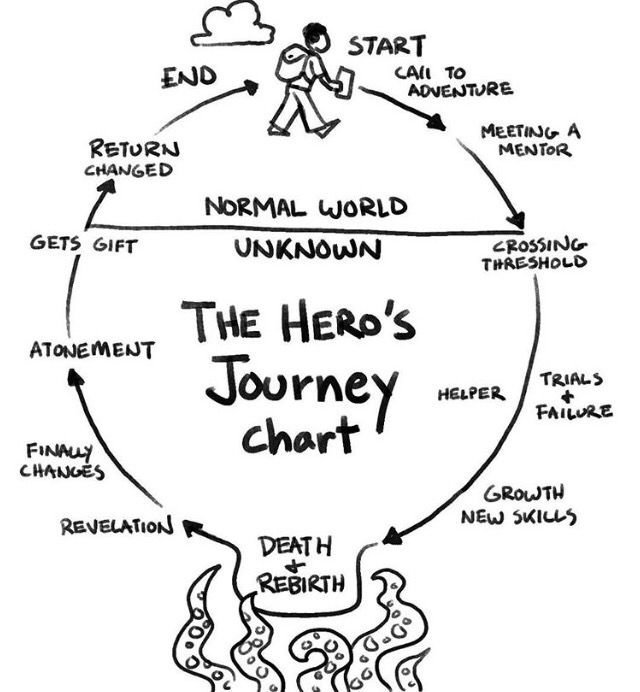
The term itself comes from the work of Joseph Campbell, The Hero with a Thousand Faces. Campbell identified a universal pattern of transformation that appears in myths across every culture. This pattern, often called the monomyth, describes a hero's journey in twelve stages: a departure, a series of trials, and ultimately a return — often marked by symbolic death and rebirth.
But the monomyth is more than a sequence of events. It contains recurring motifs: archetypes of life stages, forces we face, and people we meet.
At the start, the hero often refuses the call to adventure. Fear, insecurity, or the pull of a comfortable life holds them back. They do not volunteer. Instead, external circumstances or the collapse of their old life forces the choice upon them. This refusal shows they are not yet ready, which makes their eventual, compelled acceptance all the more powerful. Either they step forward, or they face disintegration in the world they once knew. Think Luke Skywalker, Frodo from The Lord of the Rings, or Neo from The Matrix.
Along the way, the hero encounters a cast of timeless characters. The Mentor offers guidance, tools, and wisdom — Obi-Wan Kenobi, Gandalf, or Morpheus.
Then they cross the threshold, entering unknown territory and leaving the familiar behind. They face trials and tribulations. They meet the Shadow who opposes them — Darth Vader or Voldemort. It may be personal: a rival. Systemic: an empire or ideology.
Ultimately, the hero faces their greatest fear. They meet the ultimate challenge and reach a breaking point. Here, they must willingly confront death. Symbolically, their former self dies — their old beliefs, naivety, or way of life — and they are reborn with greater knowledge or power. This is the moment of transformation. By letting go of fear or facing it despite the odds, they overcome the shadow. And only then can they return to the ordinary world, carrying the elixir.
Why Hero’s Journey Arc Matters?
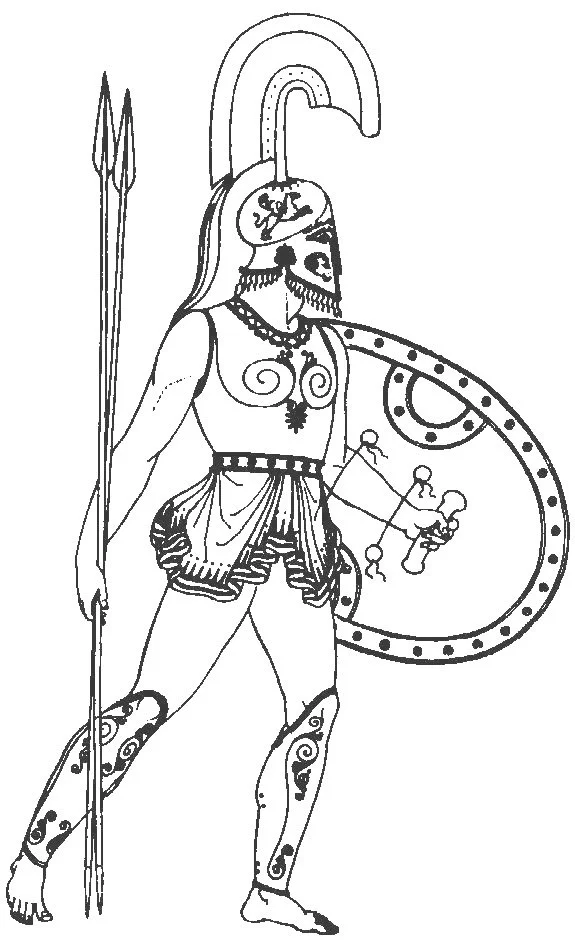
The term 'hero' is crucial here because it represents the act of breaking free. In English, the word derives from the Greek hērōs, a word used in antiquity to describe figures of strength and courage, most notably Heracles, known to the Romans as Hercules.
He was the son of Zeus and the mortal woman Alcmene, half-god, half-human. And Hera, Zeus's wife, was not punishing her own husband. She was persecuting the living proof of his betrayal.
Driven mad by Hera, Heracles murdered his wife and children. When he regained his sanity and realised what he had done, he sought atonement. The Oracle at Delphi instructed him to serve King Eurystheus for twelve years and perform whatever labours were set for him. This servitude and the Twelve Labours became both his punishment and his path to redemption.
His story represents the earliest written record in Western mythology of one who broke his fate, despite the cruel destiny bestowed upon him at birth. This myth reveals something deeper. That we can carry the weight of what came before us. Family patterns. Inherited guilt. Unspoken rules. Heracles is not punished merely for what he did, he is punished for what he was born into.
For centuries, people believed that the gods controlled everything. Symbolically, we might interpret this as our fate, our destiny, even our suffering. Often we unconsciously live the story handed to us.
Yet Heracles changed that. He did not escape his heritage. He faced it, challenged it, and transformed it.
Step by step, labour by labour, year by year, he forged something entirely new. He learned how to grow. He learned how to embrace challenges, how to find smarter ways, and how to ask for help.
The arc represents the part in each of us that can break patterns, challenge old stories, and face the darkness. To transform. To live with genuine intent. The Hero carries the spark that says this: 'You are not what happened to you. You are the one who chooses who to become.' This is where true psychological sovereignty begins.
Psyche - The Heroine Story Arc
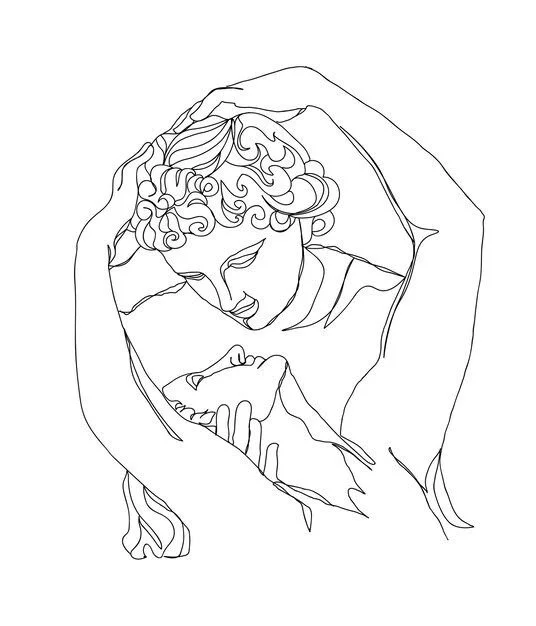
Psyche, the feminine counterpart to Hercules, represents the inner journey of the soul. In Greek, her very name means ‘soul’ itself. Her myth remains one of the most enduring stories of transformation in mythology: a map of the soul’s path to self-realisation through the power of love.
The story begins with Psyche as a mortal, a woman so beautiful she provoked the jealousy of Aphrodite (Venus). The goddess sent her son, Eros (Cupid), to make Psyche fall in love with a monster, but he was wounded by his own arrow and fell in love with her instead. He visited her each night in secret, yet he forbade her to look upon his face. When Psyche eventually disobeyed and looked upon him, Eros fled.
To win him back, she was forced to endure four impossible tasks set by Aphrodite, culminating in a descent into the Underworld. A symbolic journey into the deepest, darkest layers of human experience and by extension, human psyche.
In Jungian psychology, Psyche represents the totality of the Self. Her story, marked by betrayal, abandonment, and a series of trials. Serves as a symbolic map of the fragmented Self: split into ego, persona, shadow, anima, and animus. Her descent reflects the necessary psychological process of facing fear and integrating the shadow. It is a death-like state followed by a rebirth, showing that the soul/our psyche must go through a process of fragmentation before it can reach wholeness.
This myth tells us that self-realisation is found not by avoiding struggle, but by moving through it. The soul fragments, falls into shadow, and forgets its own nature, only to be reawakened by love. Love is the alchemist. The force of connection and presence that brings us back. It is the power that transforms the fragmented pieces of our experience into a unified whole.
You Are the Hero
The Hero's journey lives in us. It is the part that faces fear, overcomes adversity, and reshapes our path. It is resilience. Agency. The refusal to be ruled by fate.Both Heracles and Psyche walked this path. Bound by fate. Given impossible tasks. Forced into darkness. They suffered, struggled, and transformed.
Both achieved apotheosis. Heracles ascended to Olympus. Psyche was granted immortality. Symbolically, this is the realisation of our fullest potential. The moment we become who we were meant to be.
Together, they offer a complete framework for growth. His is the outward journey: action, mastery, labour. Hers is the inward journey: descent, feeling, integration. We need both. The world and the self. The fight and the surrender.
This is a roadmap. It helps us understand where we have been, where we are going, and why the hard parts matter. It gives direction. It helps us find purpose and meaning. It is a map of personal transformation.
Every hero discovers this: we are capable of far more than we imagined. We gain wisdom. We build strength. We learn to navigate the familiar and the unknown.
The deepest lesson? We create our own reality. Our inner world — intentions, fears, beliefs — shapes our outer world. This demands accountability. For our actions. For our impact. For our lives. Growth requires discomfort. Ultimately, we are the agents of our own transformation.
The Hero arc is an invitation. To face fear. To choose courage. To forge our own path. And to return, at last, to our Self.
The Hero’s Journey It Is Your Very Biology’s Blueprint For Rebirth.
Most people like to think insight is enough. It is not. It is only the beginning of the journey. Real change takes place when we embody it, when we live it. Healing takes time, effort, and work. When we continuously decide to make different choices, in time that change changes us, quite literally. In fact, it is a neurobiological process.
Your brain, your nervous system, your inner chemistry, your thoughts, your emotions. The entire you changes. Body. Mind. Spirit. All become transformed.
Think about it. And let me dazzle you with science for a moment.
Your crisis — that breakdown, rock bottom — pushes your brain into plasticity. Not gently. It forces the system to reboot. Old identities, the ones you built to survive, begin to dissolve. Not because you read a book. Because you had no choice.
Your journey — the inner work — disrupts those old survival loops. It quiets the Default Mode Network, the part of your brain that keeps replaying the past and worrying about the future. When that noise settles, you can finally install new software. Rewrite the narrative. Choose a different story.
Your trials — shadow work, somatic practices, learning to regulate — rebuild neural pathways. Not through thinking alone. Through felt experience. Through sitting with what hurts.
Your return — that is the healing. The change anchors itself where it matters most: in your body. In how you move through daily life. That is transformation. Not abstract. Not imaginary. Embodied.
As Lao Tzu said: "Knowing yourself is true wisdom. Mastering others is strength. Mastering yourself is true power."