
A Guide to Tarot and the Elements
Tree of Life: The Four Worlds of Experience
Understanding the Tree of Life, the Four Worlds, and the Four Elements
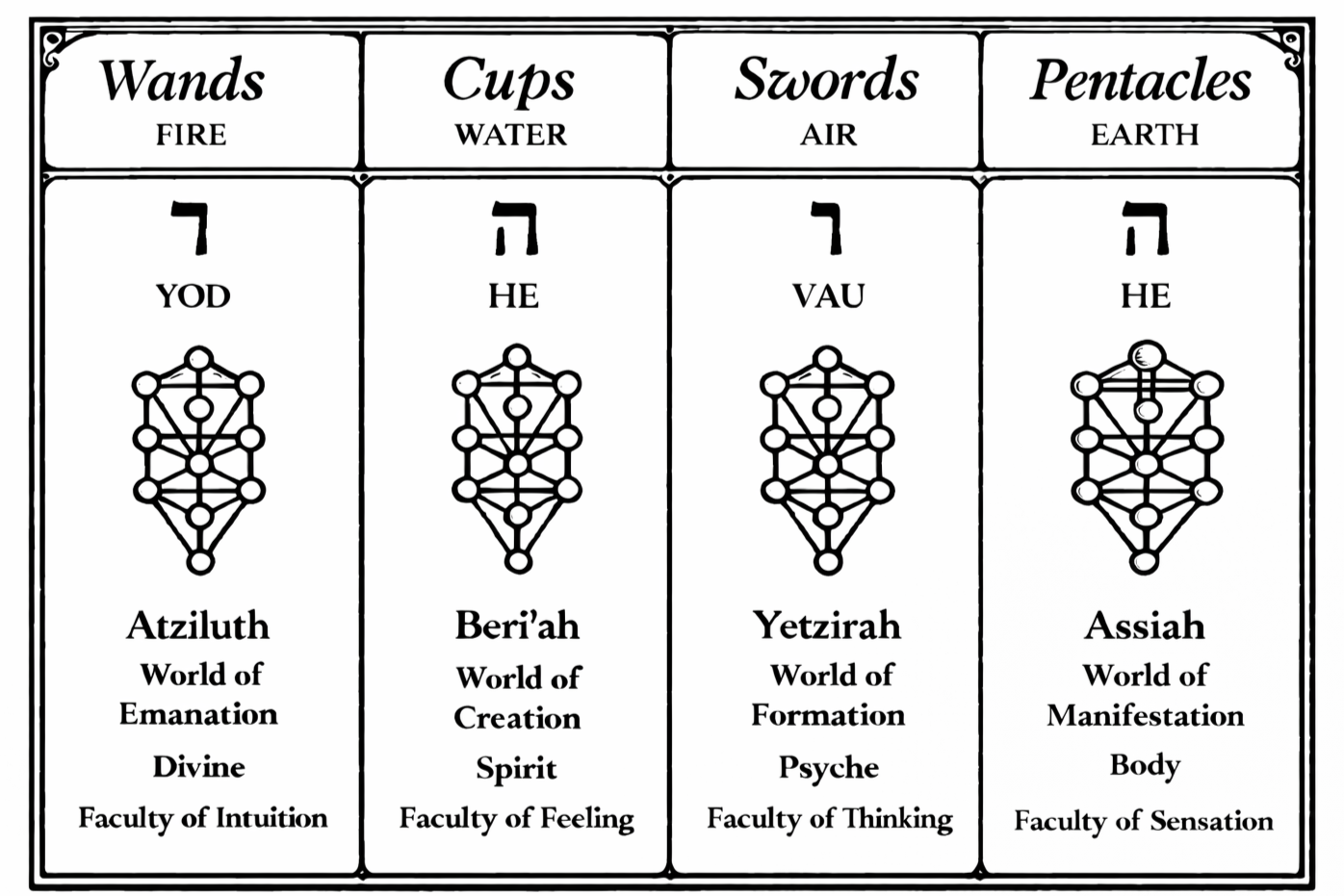
The Tarot is more than a collection of symbolic images. Beneath the surface lies a structure that connects it with one of the oldest philosophical systems in the Western esoteric tradition: the Kabbalistic Tree of Life.
The Tree of Life describes how existence unfolds from subtle spiritual potential into the physical world. In this model, creation moves through four distinct levels known as the Four Worlds. Each world represents a stage in the process through which inspiration becomes thought, feeling, and finally material reality.
These four worlds correspond closely with the four elements of classical philosophy and with the four suits of the Tarot. When viewed together, they reveal a coherent map of both the cosmos and the human psyche.
Understanding this structure allows us to see how ideas, emotions, thoughts, and actions arise and interact in everyday life.
The Four Worlds of the Tree of Life

In Kabbalistic teaching, reality unfolds through four levels known as the Four Worlds. These worlds do not refer to physical locations. Rather, they describe layers of experience through which creation moves from potential to manifestation.
The first world is Atziluth, the World of Emanation. This is the most subtle level, where the original impulse of creation appears as pure energy or inspiration. At this stage there is no form yet, only the beginning of possibility.
The second world is Beri'ah, the World of Creation. Here the original impulse begins to take shape. Emotion, meaning, and relationship emerge as the creative spark develops into something that can be felt and understood.
The third world is Yetzirah, the World of Formation. In this realm, ideas become structured and organised. Thought, language, and mental clarity allow the emerging pattern to take shape and direction.
The final world is Assiah, the World of Manifestation. This is the level of physical reality. What began as inspiration and passed through emotion and thought now appears in tangible form.
These four worlds also correspond to four fundamental human faculties: intuition, feeling, thinking, and sensation. In this way, the structure of the Tree of Life mirrors the way human experience unfolds.
Fire and the World of Atziluth
Wands and the Spark of Inspiration
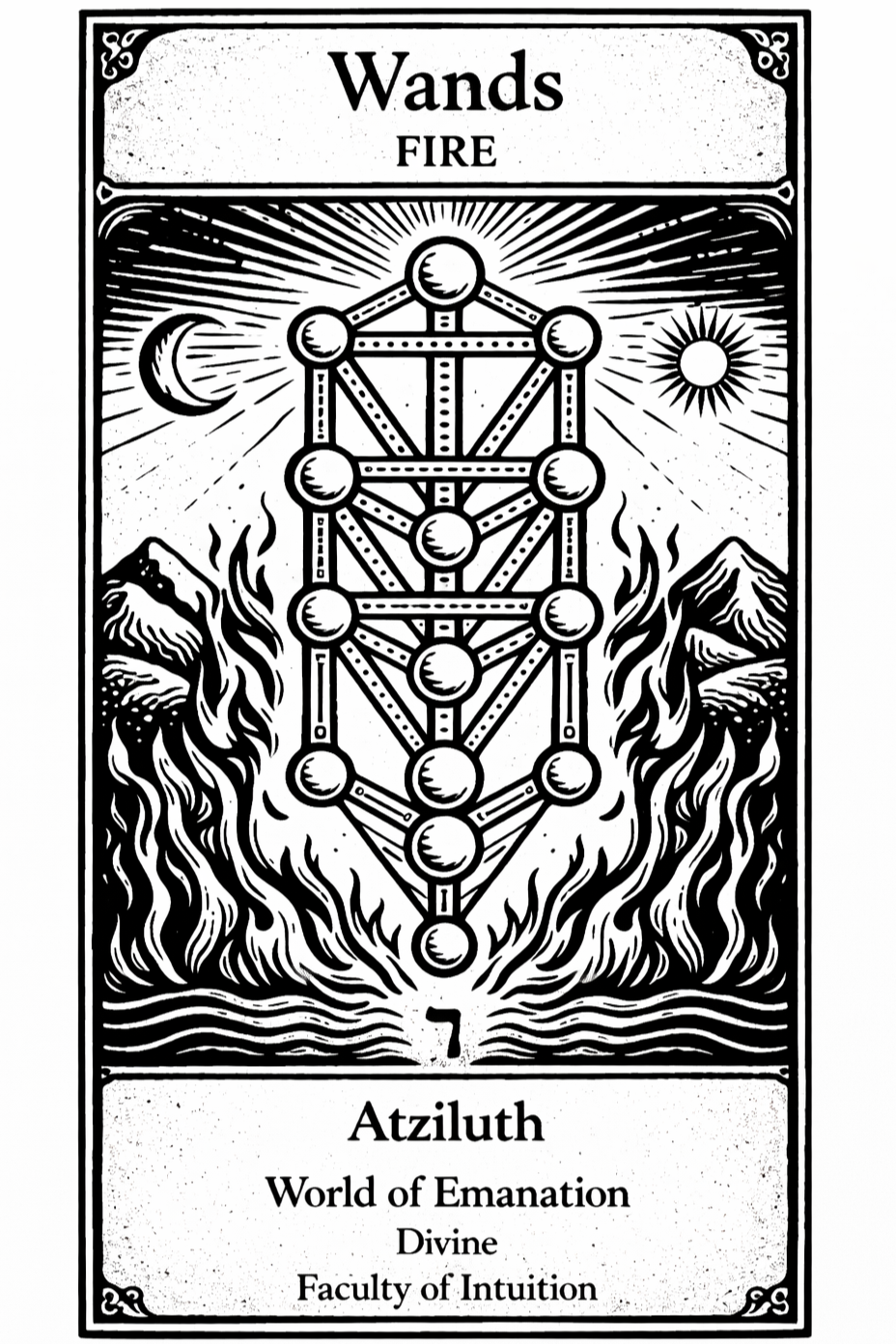
The element of fire corresponds to the world of Atziluth and to the suit of Wands in the Tarot.
Fire symbolises vitality, creativity, and the initial spark that sets events in motion. It represents the moment when an idea or impulse first appears, before it has taken form or been analysed.
This level of experience is closely related to intuition. Intuition allows us to recognise possibilities and direction without the need for deliberate reasoning. It is the source of inspiration, vision, and the courage to begin something new.
In Tarot symbolism, the suit of Wands reflects this dynamic energy. Wands represent initiative, ambition, and the drive to move forward. They speak about potential, creative momentum, and the power of intention. In the language of the Kabbalistic worlds, Atziluth represents the level where divine intention first emanates into awareness.
Water and the World of Beri'ah
Cups and the Depth of Feeling
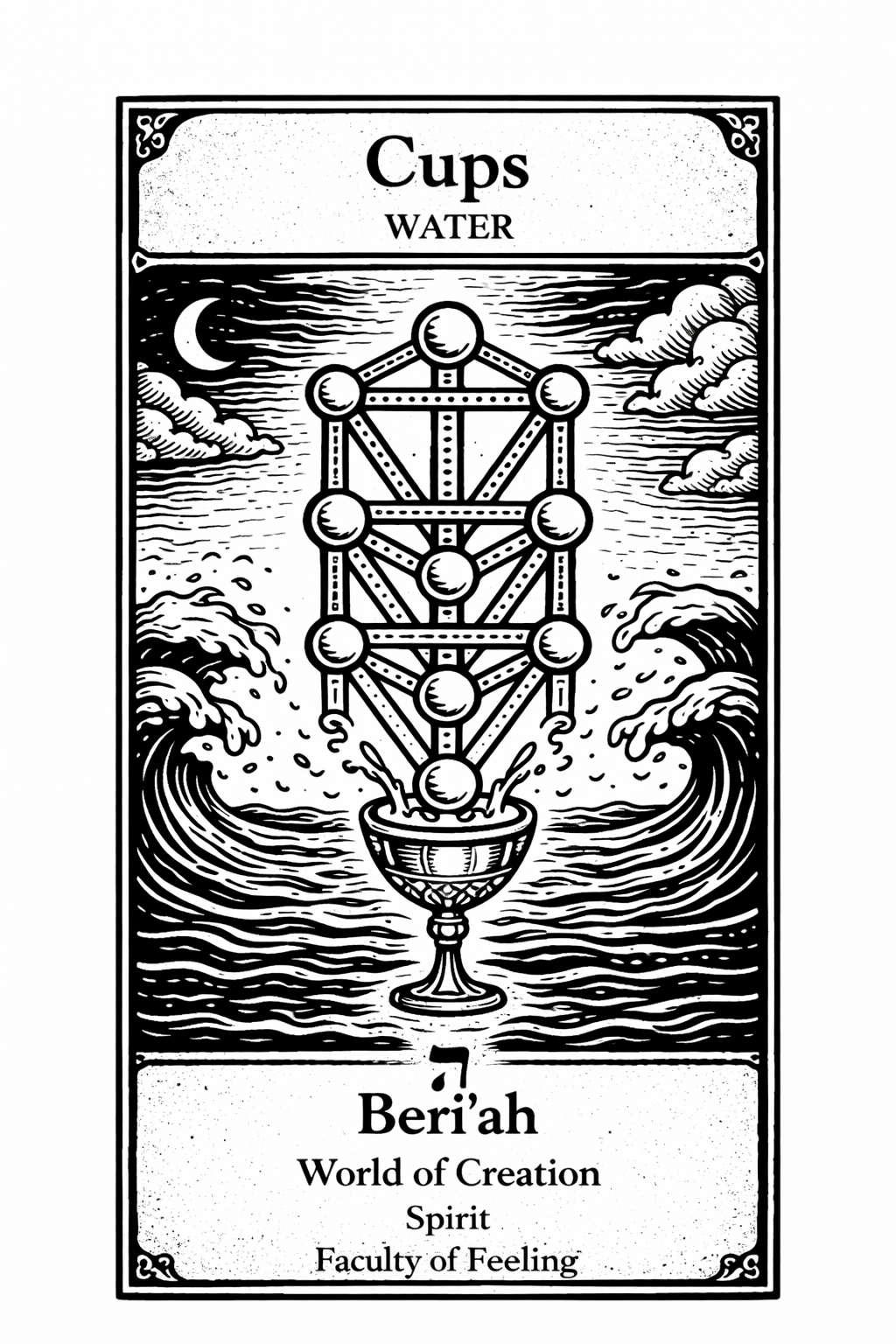
The element of water corresponds to the world of Beri'ah and to the suit of Cups.
Water represents emotion, empathy, and the inner life of feeling. It gives depth and meaning to the initial spark of inspiration. Through feeling, ideas become connected to values, relationships, and personal significance.
This level of experience relates to the human faculty of feeling. Feeling helps us recognise what matters, what resonates with us, and how we connect with others.
In Tarot, the suit of Cups reflects emotional awareness and relational experience. Cups explore themes of love, compassion, imagination, and the subtle currents that shape our inner world. At this stage, experience becomes shaped by meaning and emotional response.
What first appeared as an impulse now begins to develop a sense of significance and connection. In the language of the Kabbalistic worlds, Beri'ah represents the level where inner experience forms around values, empathy, and the recognition of relationship.
Air and the World of Yetzirah

Swords and the Realm of Thought
The element of air corresponds to the world of Yetzirah and to the suit of Swords.
Air represents intellect, language, and the capacity to think clearly. At this stage, ideas begin to organise themselves into concepts and plans. Thought provides structure and definition.
This level of experience relates to the faculty of thinking. Thinking allows us to analyse, compare, question, and understand. It helps transform inspiration and emotion into clear direction.
The Tarot suit of Swords reflects the power of the mind. Swords reveal how we interpret reality, confront challenges, and search for truth. They represent clarity, conflict, decision making, and intellectual insight.
At this stage, experience becomes organised through patterns of understanding. Ideas that emerged through intuition and were shaped by feeling are now examined, articulated, and clarified. In the language of the Kabbalistic worlds, Yetzirah represents the level where inner experience takes form through thought, interpretation, and the creation of mental structures that guide action.
Earth and the World of Assiah

Pentacles and the World of Manifestation
The element of earth corresponds to the world of Assiah and to the suit of Pentacles.
Earth represents the physical world. It is the realm of action, work, resources, and the body. At this level, ideas move beyond imagination and become tangible.
This stage corresponds to the human faculty of sensation. Sensation connects us to the physical environment through our senses and through direct experience.
The Tarot suit of Pentacles reflects this practical dimension of life. Pentacles speak about stability, effort, growth, and the process of bringing ideas into concrete form.
At this stage, potential becomes reality through action and material engagement. What began as inspiration, was shaped by feeling, and clarified through thought now takes form in the physical world. In the language of the Kabbalistic worlds, Assiah represents the level where experience becomes embodied through work, interaction with matter, and the practical consequences of our choices.
From Inspiration to Manifestation

When viewed together, the four elements and the four worlds describe a continuous cycle through which experience unfolds.
Every creation begins with a spark of inspiration. That spark gains depth through feeling, becomes clear through thought, and eventually takes form through action.
Fire introduces the impulse to begin.
Water gives emotional meaning.
Air provides clarity and structure.
Earth brings the process into reality.
This pattern appears not only in symbolic systems such as Tarot and Kabbalah but also in everyday life. Every decision, creative project, and personal transformation follows the same movement from possibility to manifestation.
The Tree of Life therefore offers more than a philosophical model. It provides a way to understand the dynamic relationship between inspiration, emotion, thought, and action.
By recognising where we stand within this process, we gain a deeper awareness of how change unfolds and how intention becomes reality.