
The Suit of Swords
The Suit of Air and Intellect
The Suit of Swords corresponds to the element of Air and governs the sphere of thought, communication, and intellectual clarity. In the Rider–Waite deck, created by A. E. Waite and illustrated by Pamela Colman Smith, these cards explore the power and challenges of the mind. They address truth, judgement, conflict, and the difficult decisions that arise through ideas and communication. Swords reveal both the strength and tension of the intellect, showing how clarity can bring insight but also confrontation.
This interpretation is grounded in the esoteric system of the Hermetic Order of the Golden Dawn, from which much of the Rider–Waite symbolism derives. Within this framework, Swords correspond to the element of Air and the Kabbalistic world of Yetzirah, the World of Formation. The suit therefore represents the domain of mental activity, where ideas take shape through thought, language, and reasoning.
All Minor Arcana are mapped to the Tree of Life based on their number. The Ace of Swords expresses the pure root of intellectual force. The numbered cards from Two to Ten show how this mental energy develops as it moves through the ten Sephiroth of the Tree of Life, revealing different stages of understanding, conflict, and resolution. The Court Cards represent distinct ways of engaging with the realm of thought and communication.
The Swords, being of the Element of Air, are all mapped to the World of Yetzirah, the World of Formation, whose colour system is known as the Prince Scale.
In readings, Swords often appear when clarity, judgement, or difficult truths must be confronted. The suit reflects how the mind shapes perception and action, while also revealing the tensions that arise from analysis, responsibility, and the consequences of thought. The Golden Dawn system further refines these meanings through astrological correspondences, adding additional layers of symbolic structure to each card.
The Ace of Swords
The Root of the Powers of Air
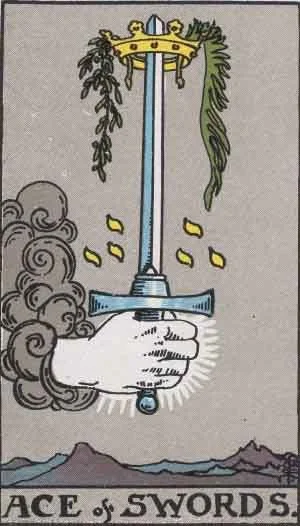
This card represents the source of the element of Air in its most concentrated and undiluted form. Its Hermetic title is The Root of the Powers of Air. On the Kabbalistic Tree of Life it is placed in Kether of Yetzirah, the Crown within the World of Formation.
The Ace symbolises the power of the mind in its purest expression: clarity, truth, justice, and the ability to discriminate and decide. The card is traditionally depicted as a radiant white angelic hand issuing from clouds, holding a sword pointed upward and crowned with the crown of the Sephiroth, from which olive and palm branches descend. In its negative aspect it can represent the misuse of intellect, tyranny, or destructive mental force.
Discover the deeper meaning of this card: The Ace of Swords — The Root of the Powers of Air
Two of Swords — Peace Restored (Chokmah)
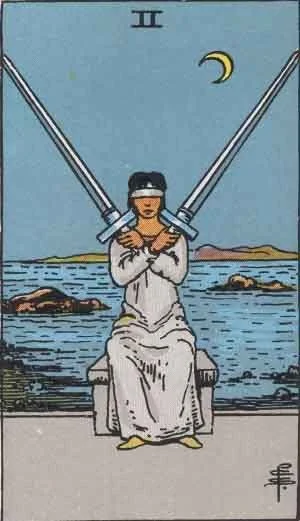
This card combines the element of Air with the expansive authority of Chokmah, the sphere of Wisdom, within Yetzirah. Its Hermetic title is Peace Restored. The astrological attribution is the Moon in Libra, where reflective lunar sensitivity meets the balanced and harmonious scales of Libra.
The card symbolises a temporary truce, neutrality, or a deliberate refusal to make a decision. It represents a state of balance achieved by suspending conflict. In the intellectual realm it reflects the beginning of stability after disturbance, though the underlying tension may remain unresolved.
Discover the deeper meaning of this card: Two of Swords — Peace Restored
Explore the astrological meaning behind: Moon in Libra
Three of Swords — Sorrow (Binah)
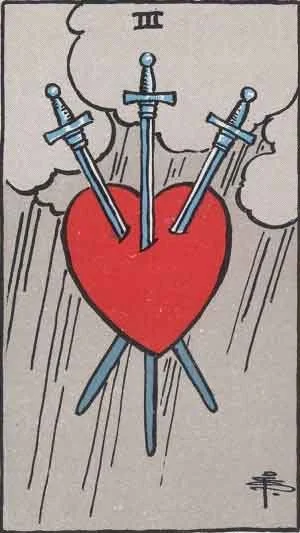
Air operating within Binah, the sphere of Understanding and the Supernal Mother, produces a card associated with sorrow and painful realisation. Its Hermetic title is Sorrow. The astrological attribution is Saturn in Libra, where the restrictive influence of Saturn weighs upon the relational balance of Libra.
Through the clarity of intellect comes the recognition of loss or disappointment. The familiar image of the heart pierced by three swords symbolises the intersection of mental insight and emotional pain.
Discover the deeper meaning of this card: Three of Swords — Sorrow (Binah)
Explore the astrological meaning behind: Saturn in Libra
Four of Swords — Truce (Chesed)

In this card the element of Air operates within Chesed, the sphere of Mercy. Its Hermetic title is Truce or Rest from Strife. The astrological attribution is Jupiter in Libra, where Jupiter’s expansive and harmonising influence brings relief to conflict.
The card represents rest, recovery, and withdrawal after mental struggle. It symbolises a period of reflection and restoration, where conflict is paused rather than permanently resolved.
Discover the deeper meaning of this card: Four of Swords — Truce (Chesed)
Explore the astrological meaning behind: Jupiter in Libra
Five of Swords — Defeat (Geburah)
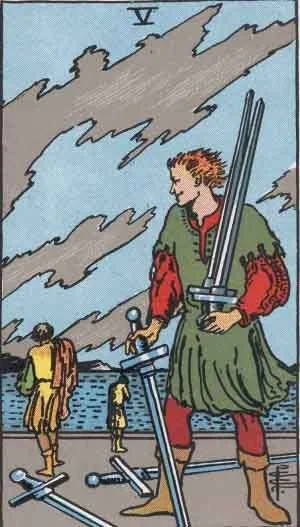
The disruptive force of Geburah, the sphere of Severity, acts upon Air in this card. Its Hermetic title is Defeat. The astrological attribution is Venus in Aquarius, where the conciliatory influence of Venus struggles within the detached and intellectual atmosphere of Aquarius.
This card represents victory gained through harsh or questionable means, often leaving conflict unresolved. The sharp quality of Air becomes aggressive and divisive, leading to hollow triumph and lingering tension.
Discover the deeper meaning of this card: Five of Swords — Defeat (Geburah)
Explore the astrological meaning behind: Venus in Aquarius
Six of Swords — Earned Success (Tiphereth)
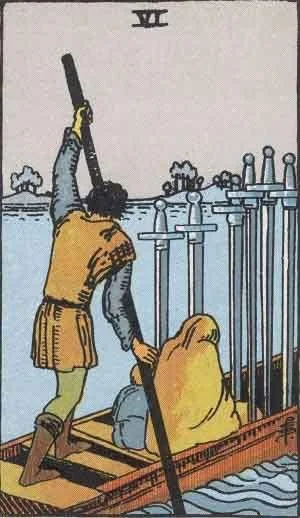
This card places Air within Tiphereth, the sphere of harmony and balance. Its Hermetic title is Earned Success. The astrological attribution is Mercury in Aquarius, where the swift intelligence of Mercury expresses through the innovative and analytical nature of Aquarius.
The card symbolises progress after difficulty. It represents movement toward calmer circumstances through reason, perseverance, and deliberate effort.
Discover the deeper meaning of this card: Six of Swords — Earned Success (Tiphereth)
Explore the astrological meaning behind: Mercury in Aquarius
Seven of Swords — Unstable Effort (Netzach)
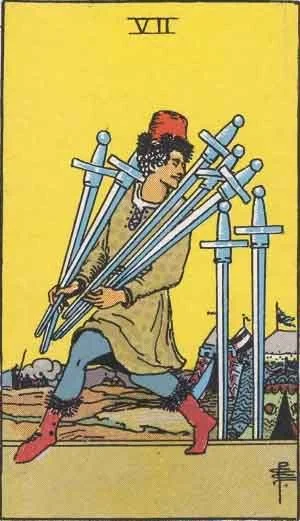
Air operating through Netzach, the sphere of instinct and desire ruled by Venus, produces this card. Its Hermetic title is Unstable Effort. The astrological attribution is the Moon in Aquarius, where emotional reflection interacts with intellectual detachment.
The card represents strategy, cunning, and attempts to achieve success through indirect means. It may indicate partial success, unreliability, or efforts that ultimately fail due to deception or instability.
Discover the deeper meaning of this card: Seven of Swords — Unstable Effort (Netzach)
Explore the astrological meaning behind: Moon in Aquarius
Eight of Swords — Shortened Force (Hod)
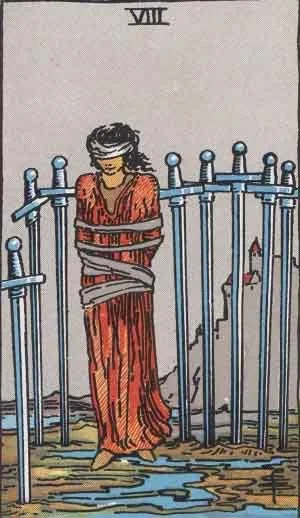
The analytical influence of Hod combines with Air in this card. Its Hermetic title is Shortened Force. The astrological attribution is Jupiter in Gemini, where expansion meets the dual and communicative nature of Gemini.
This card represents restriction, limitation, or mental entrapment. Thought becomes constricted, creating indecision and a sense of being trapped by circumstances or one’s own thinking.
Discover the deeper meaning of this card: Eight of Swords — Shortened Force (Hod)
Explore the astrological meaning behind: Jupiter in Gemini
Nine of Swords — Despair and Cruelty (Yesod)
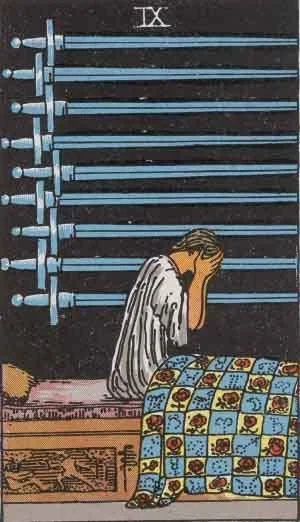
Air operating within Yesod, the lunar sphere of reflection and dreams, produces this card. Its Hermetic title is Despair and Cruelty. The astrological attribution is Mars in Gemini, where aggressive Martian energy agitates the restless intellect of Gemini.
The card symbolises anxiety, worry, and mental anguish. The reflective nature of Yesod magnifies troubling thoughts, creating a state in which fears appear overwhelming and inescapable.
Discover the deeper meaning of this card: Nine of Swords — Despair and Cruelty (Yesod)
Explore the astrological meaning behind: Mars in Gemini
10 of Swords — Ruin (Malkuth)
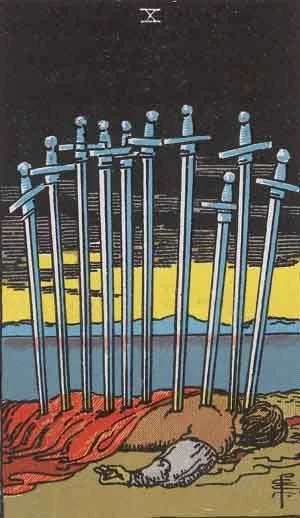
This card represents the final manifestation of Air within the material world, corresponding to Malkuth on the Tree of Life. Its Hermetic title is Ruin. The astrological attribution is the Sun in Gemini.
The card symbolises the complete exhaustion of a mental pattern or the decisive ending of a situation. Although stark, it represents the final point of a cycle, after which renewal becomes possible.
Discover the deeper meaning of this card: 10 of Swords — Ruin (Malkuth)
Explore the astrological meaning behind: Sun in Gemini
Court Cards of Swords: Masters of Air
The Golden Dawn system assigns elemental dignities to the Court Cards. Each card combines the element of Air with one of the four elemental sub qualities, producing distinct expressions of intellectual authority and psychological power.
Page of Swords — Earth of Air
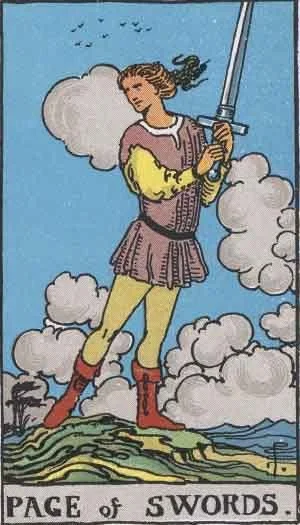
The Page of Swords (Princess) represents the Earth of Air. In the Golden Dawn system she corresponds to the Princess, the grounded manifestation of intellectual potential.
She is the earthy manifestation of Air. She is the intellect grounded in the real world—the seed of mental potential that needs direction and cultivation to grow. She is observant, curious, and vigilant, but can also be overly analytical or critical. She carries the potential for sharp thinking but is still immature and impressionable.
She symbolises curiosity, observation, and the development of analytical thought. Although perceptive and intelligent, her understanding is still developing and requires experience to mature.
Discover the deeper meaning of this card: Page of Swords — Earth of Air
Knight of Swords — Air of Air
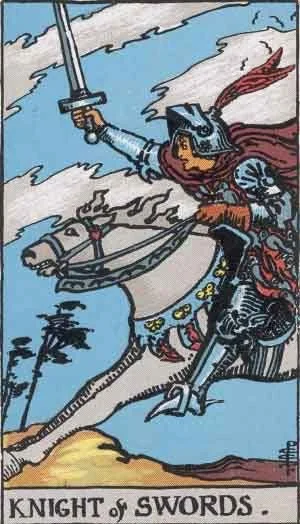
The Knight of Swords (Prince) represents the Air of Air. In the Golden Dawn system he corresponds to the Prince, he is the active, swift, and forceful messenger of the mind He corresponds to the active, initiating aspect of intellect.
He is sharp, intelligent, and direct, but can be cutting, argumentative, and domineering in his communication. He pursues his mental ideals with passion and speed, embodying the quest for truth and understanding.
Discover the deeper meaning of this card: Knight of Swords — Air of Air
Queen of Swords — Water of Air
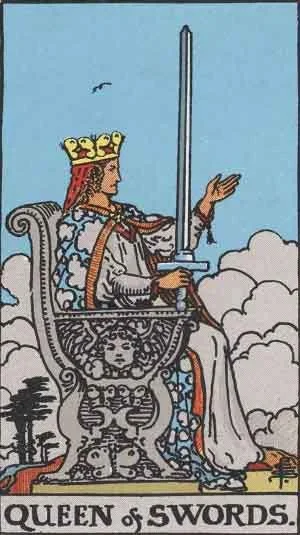
She is the receptive and intuitive side of intellect. In the Golden Dawn, she corresponds to the Water part of Air, the nurturing, perceptive aspect of mental energy. She is perceptive, independent, and communicates with clarity and empathy, having mastered the sharpness of Air. She embodies the penetrating insight that cuts through illusion with compassion.
Discover the deeper meaning of this card: Queen of Swords — Water of Air
King of Swords — Fire of Air
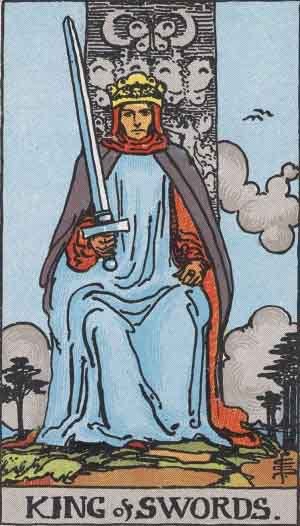
He is the ultimate expression of the suit's intellectual energy, the King, the Fire of Air. He is the active, commanding, and authoritative expression of intellect. The master of thought and communication. He embodies pure intellect, logic, and justice, wielding his mental power with executive force and decision-making authority.
In alchemical terms, he represents the completed stage of the airy opus, where the mind is wielded with wisdom and authority.
Discover the deeper meaning of this card: King of Swords — Fire of Air