
The Four Colour Scales of the Golden Dawn
Hermetic, Kabbalistic and Magical Applications
The Secret of Colour
In the Hermetic Order of the Golden Dawn, colour was regarded as one of the most profound and carefully guarded secrets of the Second Order (the Inner Order of adept grades). The First Order (Outer Order) operated almost entirely in black and white: ritual regalia, temple furnishings, and instructional materials were deliberately monochrome. This created a striking psychological effect: when candidates were initiated into the Second Order, they stepped "over the rainbow" from a black-and-white world into one saturated with vibrant, symbolically charged colour. This transition was described as "quite effective" and intentionally disorienting, marking the crossing from exoteric instruction to esoteric revelation.
The colour system of the Golden Dawn was not merely decorative but functional, a technology of consciousness designed to attune the magician to specific spiritual frequencies and facilitate movement between the Four Kabbalistic Worlds.

The Four Worlds and Their Colour Scales
The names of the scales—King, Queen, Prince, Princess—derive from the court card titles used in the Golden Dawn system. These titles also correspond to the four elements in their hierarchical arrangement.
The four colour scales correspond directly to the Four Kabbalistic Worlds through which the divine light descends from the Infinite into material manifestation.
The Nature of Each Scale
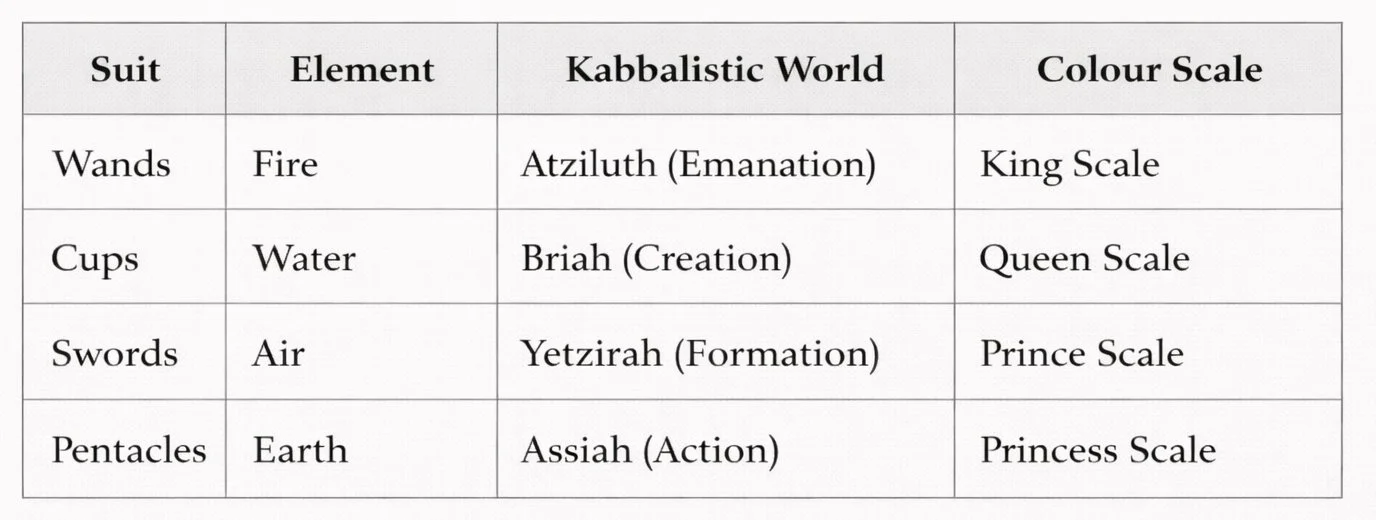
King Scale (Atziluth - Fire): Represents the "natural essence of colour"—the pure, undiluted spiritual archetype before any refraction or reflection. These colours are bold, primary, and direct, emanating from the divine source itself.
Queen Scale (Briah - Water): Represents "the colours we perceive from reflected light and are taken from nature". These colours are softer, more nuanced, and correspond to the way spiritual energies appear when filtered through the creative imagination.
Prince Scale (Yetzirah - Air): A "blend of the Knight and Queen scales". These colours represent the interpenetration of pure essence and reflected form—the active intelligence that shapes spiritual energy into communicable patterns.
Princess Scale (Assiah - Earth): A "variety of combinations and shades of the colours that have come before". These are the most complex and dense colours, representing spiritual energy fully manifested in the physical world. This scale was considered potentially dangerous for the unprepared, as it "make[s] the borders between the physical and astral worlds much more transparent and easy to pass".
The Origins and Sources
The colour scales were not arbitrary inventions but were synthesised from several esoteric traditions.
Kabbalistic sources: The Four Worlds themselves provided the structural framework
Hermetic philosophy: The principle of correspondence ("As above, so below") governed the relationships between scales
Renaissance magic: Colour attributions from earlier grimoires and magical systems
Alchemical tradition: The colour stages of the Great Work (Nigredo, Albedo, Citrinitas, Rubedo) informed the progression
Practical experimentation: Members of the Order developed and refined the system through magical work
The colours were also influenced by the Winsor and Newton paint catalogue—the specific pigments available to Victorian occultists. This practical consideration meant that the scales were designed to be actually paintable by initiates creating their own magical implements and Tarot decks.
How the Colour Scales Were Used
1. Tarot Card Illumination
Perhaps the most famous application of the colour scales was in the creation of magical Tarot decks. Members of the Golden Dawn were required to paint their own decks according to the specific colour attributions of each card. This was not an artistic exercise but a magical operation, the act of applying the correct colours to each card was a form of meditation and attunement.
Each card's colours were determined by its position on the Tree of Life. For example, the Fool (Path 11, connecting Kether to Chokmah) is coloured according to its path in the Four Worlds:
King Scale (Atziluth): Pale Yellow
Queen Scale (Briah): Baby Blue (or Pale Blue)
Prince Scale (Yetzirah): Turquoise White (or Greenish Grey)
Princess Scale (Assiah): Pastel Green flecked with Yellow (Yellow-Green)
The resulting cards were often striking but not necessarily "appealing" by conventional aesthetic standards. Their purpose was magical efficacy rather than visual beauty.
2. Astral Projection and Scrying
The colour scales served as navigational tools for astral exploration. When a magician wished to visit a specific Sephirah or path on the astral plane, they would use the appropriate colour scale as a "ladder" or "tunnel" to reach that destination.
Practical technique (adapted from Frater Yod's "Ladders" method):
Preparation: Relax, balance posture, practise rhythmic breathing, quiet the mind
Attunement: Meditate upon the corresponding Tarot card
Princess Scale immersion: Visualise being surrounded by the Princess Scale colour of the target sphere or path (the densest, most manifest form)
Progression: Allow consciousness to rise through the scales, from Princess to Prince to Queen to King, feeling the shift in energy at each level
Breakthrough: At the King Scale level, experience the pure archetypal essence of the sphere or path
The colours provide "one bit of evidence that you may be on the right track" during astral exploration. If you arrive at a landscape ablaze with orange hues, and you know that orange is the Queen Scale colour of Hod, you have confirmation of your location.
3. Ritual Magic and Invocation
In ceremonial magic, the colour scales were used to move energy through the Four Worlds. By combining the appropriate colour with the corresponding divine names (from each world), the magician could effectively invoke specific forces.
For example, in designing a ritual to invoke the energies of a particular Sephirah, the magician would:
Use King Scale colours for invoking the pure archetypal force
Use Queen Scale colours for visualisation and meditation
Use Prince Scale colours for ritual tools and symbols
Use Princess Scale colours for talismans and physical manifestations
4. The Minutum Mundum: The Coloured Tree of Life
The most famous visual representation of the colour scales is the Minutum Mundum ("Little World"), the coloured Tree of Life diagram revealed in the 5=6 initiation of the Second Order.
In this diagram:
The Sephiroth (spheres) are coloured in the Queen Scale (feminine, receptive) because they represent states, plateaus, and receptacles of light
The Paths are coloured in the King Scale (masculine, active) because they represent the streaming power, movement, and transmission of light
This distinction reflects a profound magical principle: the Sephiroth are destinations; the Paths are journeys. The feminine spheres receive; the masculine paths transmit.
The Princess Scale was used more rarely, and only in specialised magical work, because its dense, manifest colours could dangerously blur the boundary between physical and astral realities for the unprepared.
5. Tattwa Vision and Elemental Work
The colour scales were integrated with the Hindu Tattwa system, another method of astral exploration practised by the Golden Dawn. Each Tattwa symbol (representing an element) has its own colour, and the scales provided a framework for moving between elemental planes.
6. Flashing Tablets and Complementary Colours
A specialised application was the creation of Flashing Tablets, magical diagrams designed to evoke spiritual vision through complementary colour contrast. The principle is that staring at a colour and then looking at a white surface produces its complementary colour in after-vision. This "flashing" effect was used to:
Stimulate astral vision
Charge talismans
Invoke specific spiritual forces
The Golden Dawn assigned complimentary colours to each scale for this specific purpose.
The Complete Colour Scales
The definitive source for the colour attributions is Aleister Crowley's Liber 777, which tabulates the correspondences for all ten Sephiroth and twenty-two Paths across all four scales. Israel Regardie's "The Golden Dawn" also contains extensive tables and explanations.
Here is a representative sample of the scales for the Sephiroth:
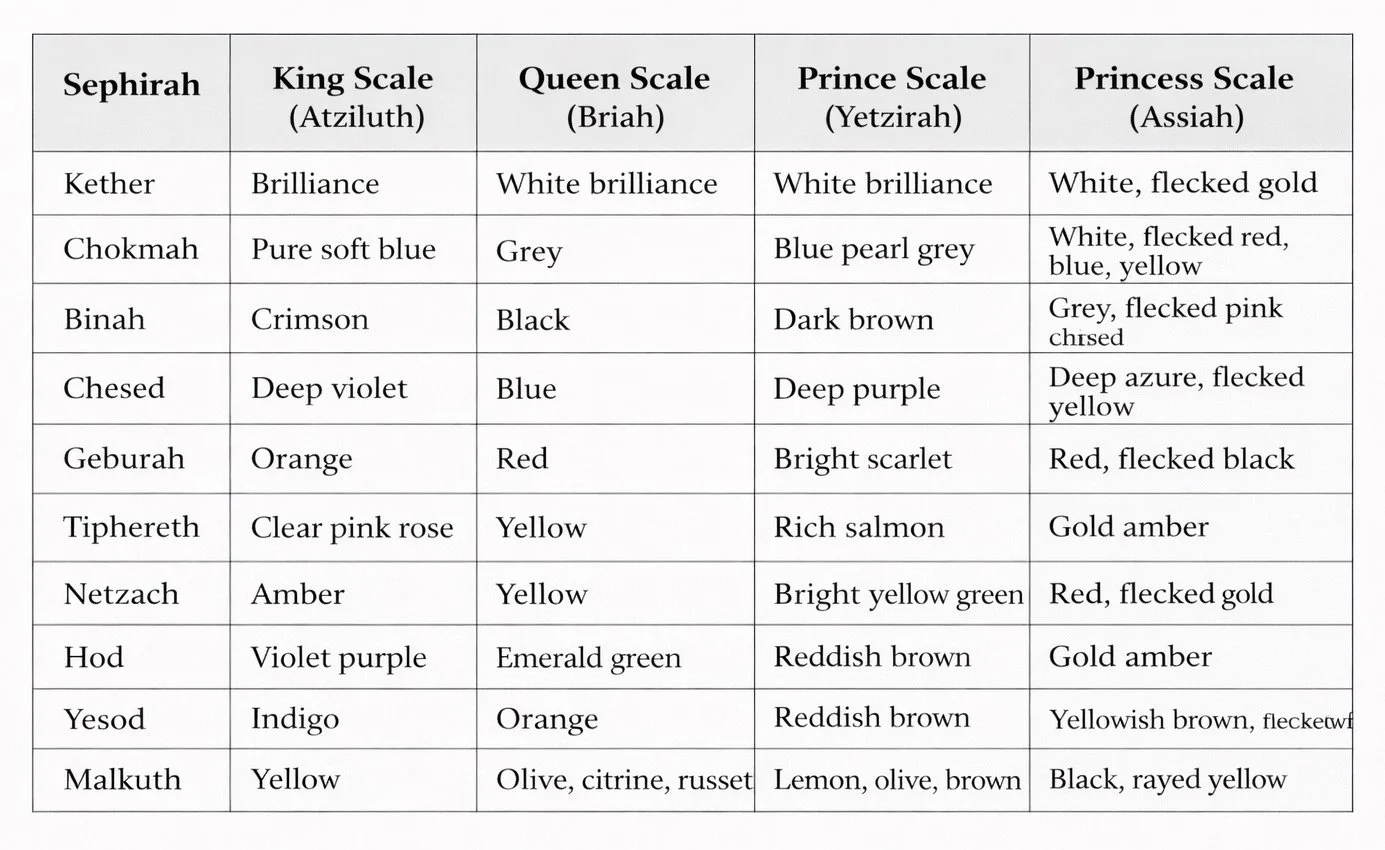
For the 22 Paths (Major Arcana), each has its own four-colour attribution based on the Hebrew letter and astrological correspondence.
The example of The Fool (Path 11) was given above.
Deeper Symbolic Meanings of Individual Colours
In the Golden Dawn system, each colour carried specific symbolic and magical meanings that informed its use across the scales:
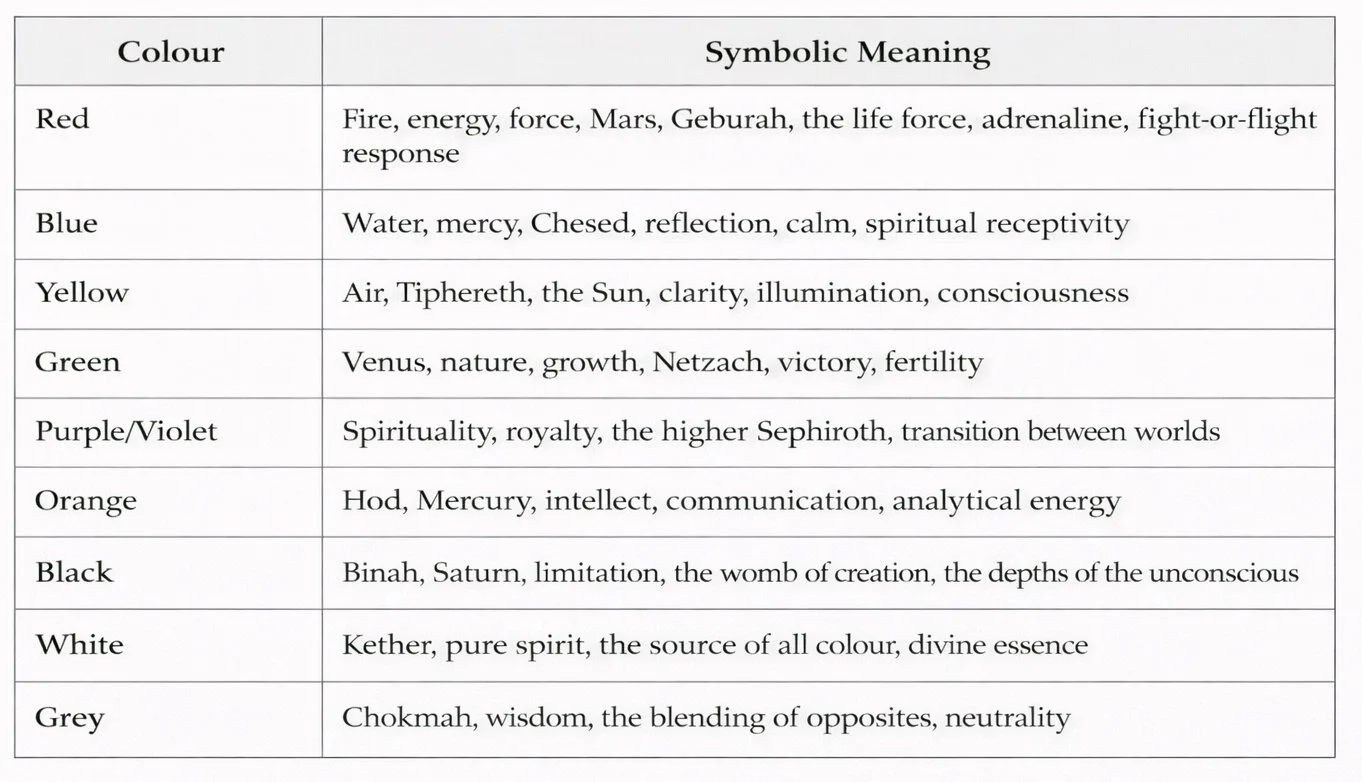
Colour psychology was also understood intuitively. Red triggers a "fight or flight" reflex and releases adrenaline, while purple is considered spiritual or regal partly because of its historical rarity and expense.
The Colour Scales in Practice: A Worked Example
To illustrate how the scales were used in actual magical practice, consider the Path of Tav (The World, Saturn, Path 32 connecting Yesod to Malkuth):
Colour attributions for Tav:
King Scale: Indigo
Queen Scale: Black
Prince Scale: Blue-black
Princess Scale: Black, rayed blue
The Ladders meditation technique:
Begin by surrounding yourself in the Princess Scale colour: black, with blue laser-like rays emanating from a central source, forming a tunnel
Float forward through the tunnel towards the convergence point, allowing speed and energy to increase
Break through into the Prince Scale realm: stark, intense blue-black light
Pause and notice thoughts and feelings
Transition to the Queen Scale: black emerging from the blue-black until it replaces it
Pause and feel the shift
Ascend to the King Scale: deep indigo, the pure archetype
Experience the essence of the Path
This technique demonstrates how colour alone—without words, symbols, or complex ritual—can serve as a complete technology for spiritual exploration.
Variations Between Different Golden Dawn Decks
It is important to note that it is not possible to know for certain that we are dealing with the “original” colour scales, because part of the Order’s training required each member to create their own deck based on the template while using individually intuited colours. Each deck creator had to choose the scales they believed to be most authentic. As a result, significant variation exists between different Golden Dawn-based decks.
The Magical Tarot of the Golden Dawn (Zalewski and Sledzinski) uses one interpretation
The Golden Dawn Magical Tarot (Cicero and Cicero) uses another
The Tabula Mundi Tarot uses "a very different set of colour scales"
Crowley's Thoth Tarot incorporates the scales but with his own modifications
Why the Queen Scale Is Most Common
Most published Trees of Life and Tarot decks use the Queen Scale for the Sephiroth and the King Scale for the Paths. This is not arbitrary but reflects the initiatic structure of the Order
The Minutum Mundum was first revealed in the 5=6 initiation
The Queen Scale colours are "safer to use" and "lead the psyche upward"
The Princess Scale was considered potentially dangerous for beginners
The King and Queen scales represent "high potencies" appropriate for adept work
As one senior adept warned, the Princess colours should not be treated lightly. In the Golden Dawn system they were considered the most volatile of the scales, capable of subtly altering perception itself. “The Princess colours are a bit dangerous to the unprepared,” he explained, “because they thin the boundary between the physical and astral worlds, making that border far more transparent, and far easier to cross.” For this reason, such correspondences were not something an instructor would casually place in front of beginners.
They belonged to a stage of the work where the student had already developed the discipline and stability required to navigate those inner thresholds safely.
Colour as a Magical Technology
The Four Colour Scales of the Golden Dawn represent one of the most sophisticated and practical magical systems ever devised. They are not merely symbolic correspondences but functional tools for:
Attunement: Aligning consciousness with specific spiritual frequencies
Navigation: Finding one's way through the astral realms
Invocation: Moving energy from the divine source into manifestation
Transformation: Progressing through the stages of the Great Work
Verification: Confirming the accuracy of spiritual experiences
The system embodies the core Hermetic principle of correspondence—"As above, so below"—applied to the spectrum of visible light. By understanding and working with these scales, the magician gains access to a ladder of lights that spans from the densest physical manifestation to the purest divine essence.
In the words of one Golden Dawn: "Colour is the key: a real ladder of lights".