
A Journey of Psyche in 22 Steps
1.The Threshold of Becoming
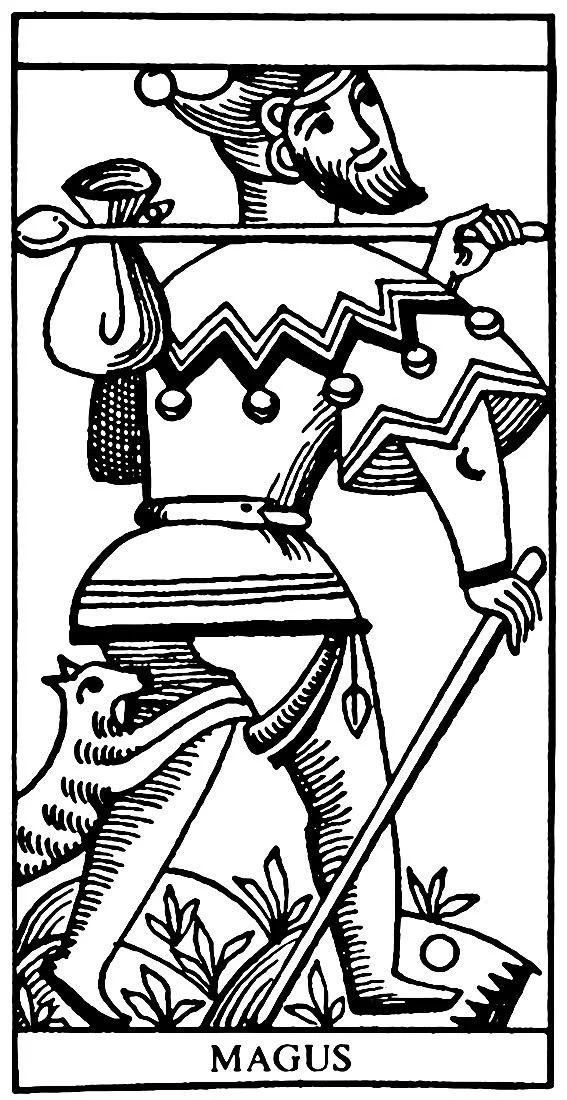
The journey begins with The Fool, numbered 0. He stands at the precipice, seemingly oblivious to the drop beneath his feet. Over his shoulder, he carries a small bundle, a collection of past experiences and memories, yet his mind is entirely on what lies ahead. At his heels, a small dog nips away, perhaps a frantic urge for caution or a final attempt to pull him back from the brink.
In Jungian terms, this is the ego at the very dawn of consciousness. It is that nascent "I" just emerging from the depths of the psyche, driven by a blind, instinctual urge to simply begin. The Fool does not necessarily know where he is going, only that he must go. It is the moment before experience has had a chance to harden into a fixed identity.
The dog is a beautiful symbolism here. Often seen as our animal nature or raw instinct, it acts as a nudge from the unconscious. It knows what the budding ego hasn't yet realised: that while the path is perilous, it is the only route to wholeness.
The number 0 is equally vital. It represents both a void and infinite potential. The Fool is empty, yet capable of becoming anything. He is the unmanifested Self before the "work" of life begins, carrying the seeds of every archetype he will eventually encounter—the Magician’s will, the Hermit’s light, and the ultimate integration of The World. He is, in essence, all of us at the threshold of becoming.
2. The Encounter with the Persona and the Shadow

Following The Fool, the opening cards trace the ego’s first forays into the world, meeting the forces that lie both outside ourselves and deep within.
I - The Magician — The active Ego. Jung viewed the ego as the centre of consciousness, the "I" that experiences, chooses, and acts in the world. The Magician's ability to consciously direct the four symbols on his table directly mirrors the ego's function of deploying the four psychological types (thinking, feeling, sensation, intuition) to engage with reality.
II - The High Priestess — The Anima/Soul and guardian of the unconscious: She represents the contra-sexual inner figure (anima in men, animus in women) that mediates between the ego and the unconscious. Her position between the pillars of light and dark, holding hidden knowledge, perfectly evokes the mysterious, intuitive quality Jung attributed to the anima as the "soul-image."
III - The Empress — The Great Mother archetype. This is one of the most fundamental patterns in the collective unconscious. Her qualities of nurturing, fertility, abundance, and connection to nature are precisely the attributes Jung assigned to this archetype in its positive aspect.
IV - The Emperor — The Father archetype: It represents structure, authority, law, and order. Where the Empress is the fertile 'yes' of creation, the Emperor provides the necessary 'no'. The boundaries that shape and protect growth. If she is the life force, he is the vessel that contains it. Together, they represent the vital tension between nurturing and structure required for an integrated Self
V - The Hierophant — Collective meaning and belonging: This card represents what Jung called the collective consciousness, the shared beliefs, values, and structures that socialise the individual. Jung emphasised that while connecting to collective meaning is necessary, over-identification with it can indeed stifle individuation. The warning about rigid adherence is therefore entirely consistent with his thought.
3.The Crisis of the Soul and the Turn Inward

The journey becomes more challenging as the ego encounters forces that force it to look beyond the established order and confront its own darkness.
VI - The Lovers — Choice and Anima/Animus encounter: The conjunction of opposites—the coniunctio—is central to his alchemical psychology, and the card's depiction of a pivotal decision between competing values reflects what Jung called the transcendent function—the psychic capacity to hold tension between opposites until a higher resolution emerges. A moment requiring conscious choice.
VII - The Chariot — Victorious Will with brittle victory: This aligns with Jung's understanding that early ego development often involves forceful repression of unconscious contents. The black and white sphinxes represent the dualities the ego must temporarily master. Jung cautioned that such victories, while necessary, can lead to inflation if the ego mistakes its temporary control for permanent supremacy hence the "brittle" quality you rightly identify.
VIII - Strength — Compassionate Mastery and shadow integration: The lion as shadow, the woman's gentle control representing conscious relationship with repressed instincts. This perfectly illustrates Jung's teaching that the shadow must be befriended, not fought. True strength lies in what he called "incorporation of the shadow" through understanding rather than suppression.
IX - The Hermit — Wise Old Man and inward turn: Jung identified the Wise Old Man as an archetype of meaning and guidance that emerges when the ego turns inward. This card marks the crucial shift from outer adaptation to inner exploration. The beginning of genuine individuation. The lantern illuminating only the next step reflects Jung's understanding that the unconscious reveals itself gradually.
4.Confrontation and Transformation
The journey now reaches its deepest and most challenging phase: a direct encounter with the most profound structures of the psyche.
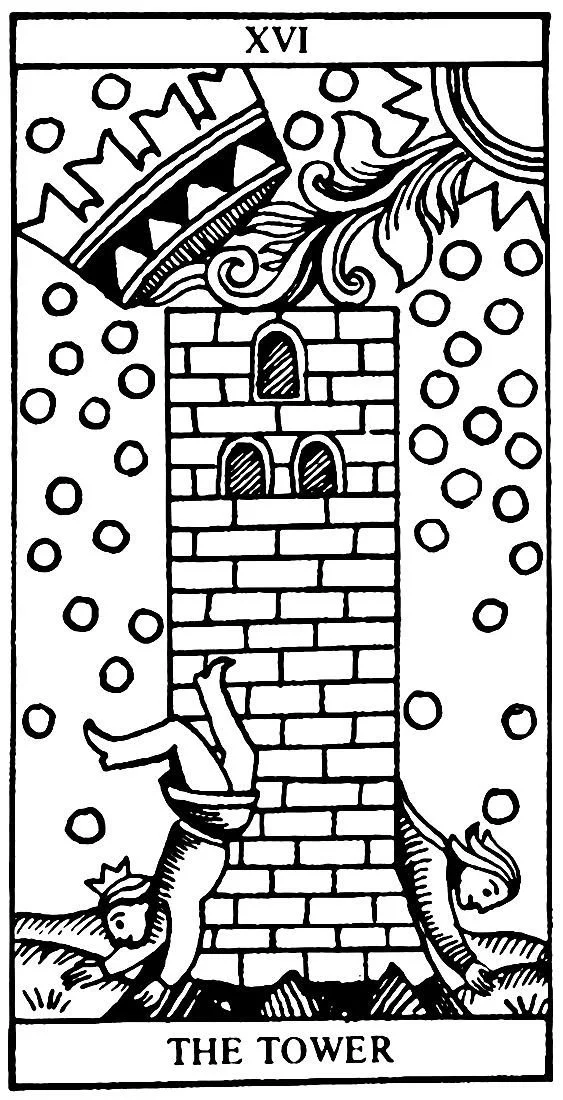
X - The Wheel of Fortune — Synchronicity and the Unus Mundus: Represents what Jung called the unus mundus, The underlying unified reality where the psyche and the physical world intersect. It is the seat of synchronicity, those meaningful coincidences that prove larger cycles are at play beyond the ego’s control. It serves as a reminder that psychological health requires a fluid flexibility. If the ego becomes too rigid, it is crushed by the turning of the archetypal tides.
XI - Justice — The Self-Regulating Psyche: It is the internal reckoning that occurs when we violate our own natural balance. The card demands the radical honesty essential for individuation: facing the consequences of our choices without the shroud of self-deception. Here, the ego must face the consequences of its actions and choices. The scales represent the delicate equilibrium between opposing psychic forces that must be maintained to achieve wholeness.
XII - The Hanged Man: A profound card representing Surrender and a Shift in Perspective. The ego is no longer in control. It is suspended, sacrificed, and forced to see the world from a completely different angle. In Jungian terms, this is the Nekyia, the night sea journey, a necessary descent into the unconscious. It's a state of suspension that precedes rebirth. The ego must let go of its old, limited viewpoint to gain new wisdom.
XIII - Death: Perhaps the most misunderstood card. It is not a prediction of physical death, but the archetype of Inevitable Transformation and Release. It represents the death of an old, outworn attitude, a relationship, a job, or a way of being. As Jung said, "Unless the ego is sacrificed, no new development is possible." The card signifies that something must end so that something new can be born. It is a necessary and natural part of the life cycle.
XIV - Temperance: Following the radical change of Death, we find Temperance. This is the archetype of Alchemical Integration and Synthesis. An angelic figure mixes water from two cups, representing the successful blending of opposites—conscious and unconscious, light and dark, spirit and matter. This is the beginning of true healing and the creation of a new, more balanced self.
5.The Emergence of the Self
Having navigated the depths, the journey now moves toward integration, wholeness, and the return to the world with a new consciousness.
XV - The Devil: This card represents the Shadow in its most material and entrapping form. It depicts the state of being chained to our own unconscious impulses, addictions, materialism, and false beliefs. It is the opposite of the freedom found in individuation. Seeing this card clearly is the first step toward breaking the chains, acknowledging the parts of ourselves we have disowned.
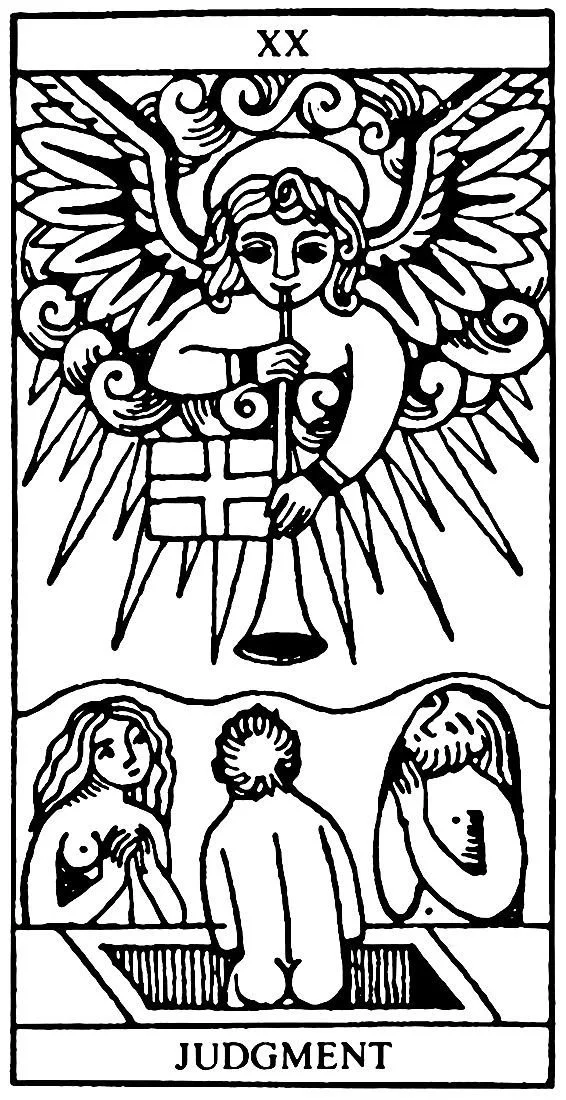
XVI - The Tower: The archetype of Sudden, Cataclysmic Awakening. This is the lightning strike that shatters the rigid structures of the ego (the tower) built on a false foundation. It is a moment of devastating, yet liberating, revelation. Old, limiting beliefs are violently destroyed to make way for a more authentic truth. It is often a painful but necessary breakthrough.
XVII - The Star: After the destruction of the Tower comes healing and hope. The Star is the archetype of Renewal, Inspiration, and Connection to the Cosmic Self. It is a moment of peace, openness, and gratitude. The ego, now humbled and more authentic, can look to the future with a sense of calm purpose and receive intuitive guidance.
XVIII - The Moon: The journey is not over. The Moon represents the archetype of The Descent into the Unconscious and Illusion. It is a realm of instinct, fear, and ambiguity. The path is unclear, and creatures of the deep emerge. This card reminds us that the unconscious is vast and not always benevolent. It tests our courage and intuition, requiring us to navigate by a light that is only reflected and often distorted.
XIX - The Sun: A stark contrast to the previous card. The Sun is the archetype of Consciousness, Clarity, and Joyful Realisation. The ego has successfully navigated the darkness and emerges into the clear light of day. It represents a time of vitality, success, and a deep, simple connection to life. The child on the horse symbolizes the birth of the true, individuated Self.
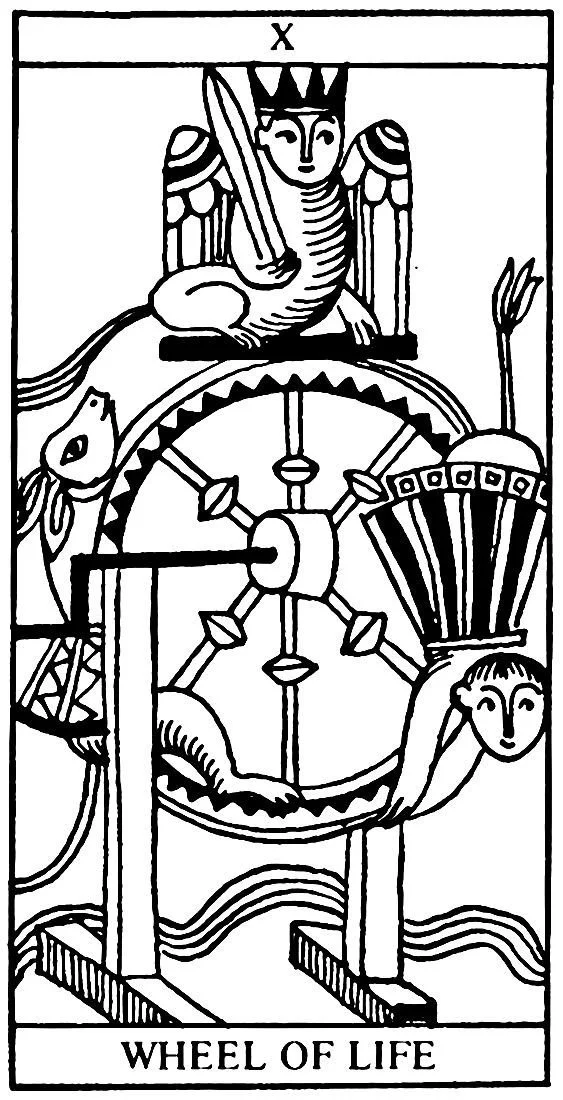
XX - Judgement: This card is about a final, profound Call to Wholeness and Reintegration. It is not judgment from an outside source, but an inner awakening, a reckoning with one's entire life. Figures rise from their graves, symbolizing the integration of all past experiences, even those long buried. It is the moment of recognizing and accepting one's true calling and purpose.
XXI - The World: The final card of the Major Arcana is the goal of the Fool's Journey: the archetype of Wholeness and the Self. The central figure dances within a laurel wreath, holding two wands, symbolizing the perfect balance and integration of all opposing forces (male/female, conscious/unconscious, inner/outer). The four fixed creatures in the corners represent the four functions now working in harmony. The Fool has completed his journey, not by becoming perfect, but by becoming whole. The ego has been integrated into the larger Self.
The Dance Without End
The journey does not end here, with The World, of course. As The World suggests a cycle completed, the Fool is ready to begin again, at a new level of consciousness, with a new bundle full of wisdom.
For The World is not a final static state of perfection, but rather a dynamic experience of wholeness in the present moment. The dancing figure within the laurel wreath is not frozen, she moves. She represents the Self in a state of harmonious flow—a living, breathing balance where the ego, the shadow, and our inner archetypes finally stop competing and start working together.
Now, however, the Fool is no longer the naive innocent. This Fool is the Wise Fool, the one who has died and been reborn many times. The bundle carries the hard-won treasures of the journey. The Magician's conscious will, the High Priestess's intuition, the Emperor's structure, the Hermit's inner light, the Strength of compassion, the Temperance of integration, and the hard-earned lessons from the Tower's collapse and the Devil's chains.
This new journey will look different. The Fool may now encounter The Magician again, but this time as a master of conscious manifestation, not just a beginner discovering his will. He may meet The Devil again, not as an external trap, but as a subtle internal attachment he thought he had already released.
The Major Arcana, therefore, is not a single story, but a mandala of transformation that we circle throughout our lives. Each complete cycle of the 22 cards deepens our understanding of ourselves and our connection to the larger whole. The Fool's journey is our journey, an eternal dance of consciousness discovering itself, one card, one moment, one lifetime at a time.