
"The Body Keeps The Score, The Psyche Tells The Story, and Love Heals The Divide."
— Synthesis of van der Kolk (Biopsychology), Jung, and Bowlby
This method draws from a confluence of well-established, well-researched psychological frameworks and models. It offers a synthesis — taking a holistic view and building on the points where these frameworks overlap and converge. One of its core foundations is the Schema Model structure. It’s designed to strengthen your self-agency and rebuild how you relate to yourself and others.
It gives you tools that help you stay centred, purposeful, and self-led — wherever life takes you. All the original schema terminology has been stripped of clinical jargon and reworked into clear, symbolic language. Each wound is now represented as a Hero Wound, paired with a corresponding Hero Mode — an archetypal sub-personality that reflects both the meaning and function of the original Schema model. Because the method adopted symbolism and archetypes, it clicks straight away. Clients don’t need to decode it — they get it. It feels familiar, instinctive, and easy to work with.
At the core of this model are 12 Hero Wounds — persistent emotional patterns that are often rooted in early life experiences. These patterns form when key emotional needs — such as safety, love, or acceptance — are unmet in childhood or adolescence. In response to emotionally painful moments like being ignored, shamed, left, pressured, or misunderstood, the brain forms enduring cognitive-emotional schemas. In those moments, we make unconscious decisions about who we are and what we must do to survive.
Over time, these beliefs become ingrained, shaping how we feel, think, and relate to others. These decisions become core beliefs — like “I’m not enough,” “I have to be perfect,” “I can’t trust anyone,” or “my needs are too much.” From these beliefs, protective behaviours emerge — ways of coping that once helped us stay safe, but now trap us in cycles of overthinking, people-pleasing, avoidance, burnout, or self-doubt. Around each core wound, we develop protective strategies — patterns of thought, behaviour, and emotional response that once helped us feel safer or more in control. These strategies were adaptive at the time — shaped by what we needed to survive.
Even if they’re no longer helpful now, they still tend to kick in under stress. They’re often driven by old, distorted beliefs about ourselves, others, and the world — beliefs we may not even realise we’re carrying. This method goes a step further by connecting our biological reality — the nervous system, the limbic system, and how the body responds to threat — with how we think, feel, and behave. That connection is often overlooked or dismissed, as if clients won’t understand it. But in practice, it’s often the piece that helps everything click. When clients realise their body is doing exactly what it was built to do — protect them and keep them alive — their patterns start to make more sense. It helps them connect the dots.
The Hero Method is built on two intersecting frameworks:
The Hero’s Journey and The Hero’s Soul Journey — each rooted in a distinct archetype that offers symbolic and psychologically meaningful structure. These two frameworks offer different — but complementary — ways of working with core wounds and beliefs.
In essence, there are two core ways to approach change: One is through conscious reflection and new behaviours. The other is through symbolic exploration and emotional integration. For example, someone with the belief “I’m not enough” might work with it consciously by noticing patterns and choosing new responses — or subconsciously, by writing to the part of them that holds that belief, uncovering its story and unmet needs. These two paths are not opposites — they intersect. Some begin with structure and find depth. Others start in the emotional and find clarity through meaning-making. Most move between both.
The Hero’s Journey
Conscious and Explicit
It focuses on awareness, repetition, and daily action — identifying core beliefs like “I’m not worthy” and challenging them through practical steps that build direction, inner structure, and agency.
The archetype of Herakles represents the Hero’s Journey — rooted in the myth of his Twelve Labours.
This arc reflects the conscious path: facing challenges directly through strength, courage, and persistence.
Hero’s Soul Journey
Subconscious and Implicit.
It works through emotional memory and the body — using creative tools like writing, visualisation, tarot, and shadow dialogue to explore the wound. It asks: “Why does my abandoned self still feel unsafe?” — and makes space to listen.
The archetype of Psyche represents the Hero’s Soul Journey— drawn from the myth of her descent to the underworld.
This arc follows a spiritual and emotionally integrative path — shaped by vulnerability, trust, and deep inner transformation.
.
in my philosophy, I'm not anchoring my method in pathology or dysfunction, but in the healthy inner guide — the co-regulated self that already exists within everyone.
We all have this core part of us that’s stable, wise, and intact — even if it’s been buried under layers of survival responses. My method is about building strength around that part, and bringing the rest of the psyche into relationship with it.
The psyche isn’t broken. It’s adaptive. Every part has formed for a reason — to protect, to survive, to cope. But the goal is not just to understand these parts — it’s to reconnect with the one who can lead them. The more we activate this core, the stronger it becomes. Like a muscle. Like a guide.
That’s the heart of the Hero Method: not fixing brokenness, but awakening the leadership within.
Core wounds
Core wounds are often rooted in childhood, these patterns shape our thoughts, feelings, and behaviours, persisting throughout our personal and professional lives. They lead us to repeat the same cycles and fall into toxic habits and relationships, commonly resulting in recurring spells of low mood and anxiety.
Wounds or patterns are essentially our negative beliefs about ourselves, others, and situations, deeply influencing our thoughts, feelings, and behaviours. They are the tricky emotional and behavioural habits we adopted early in life and continue to carry with us. Often rooted in childhood experiences where our emotional needs were unmet or we felt unsafe.
Core wounds RESPONSE MAPPING | HERO METHOD MODES & THE LIMBIC SYSTEM
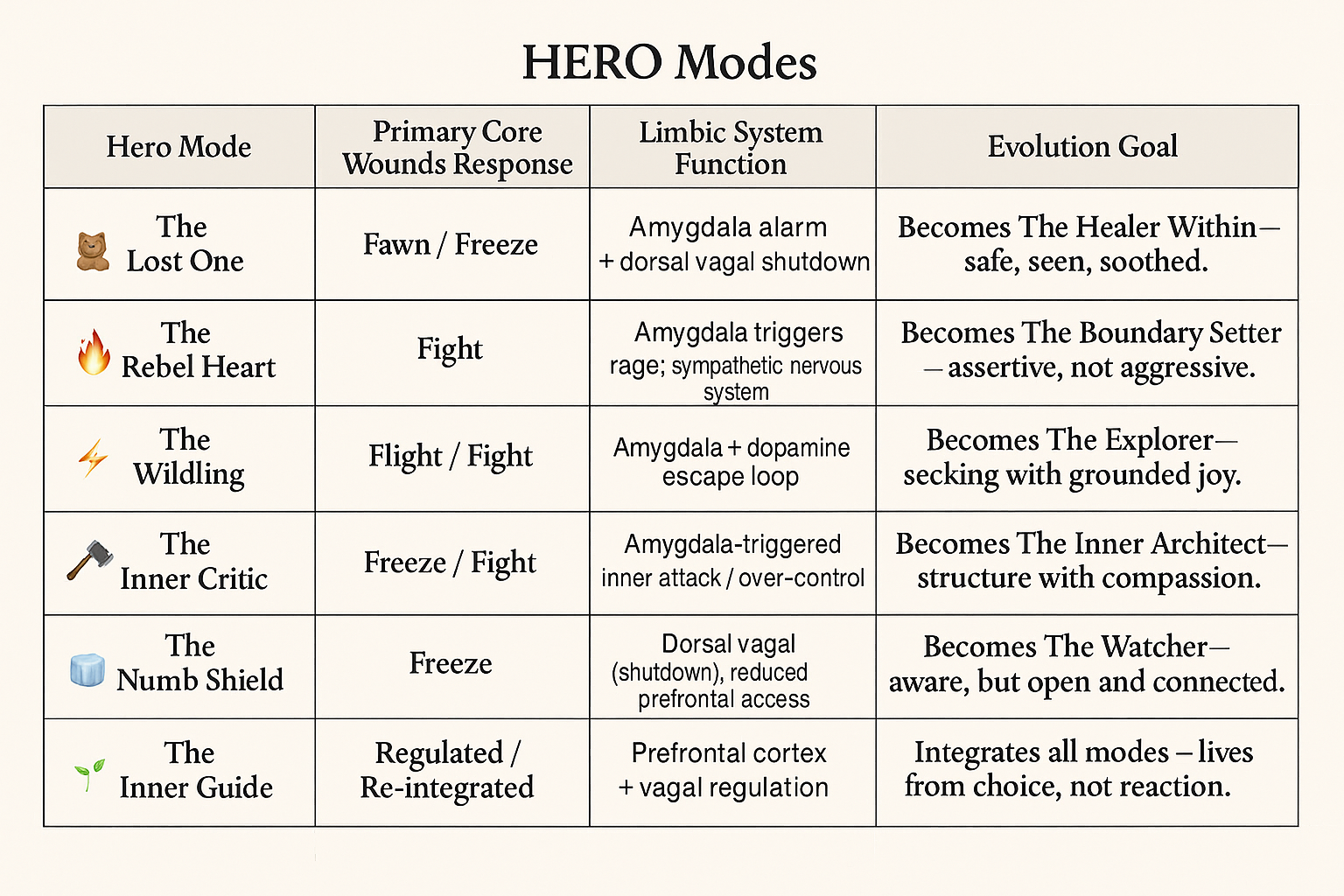
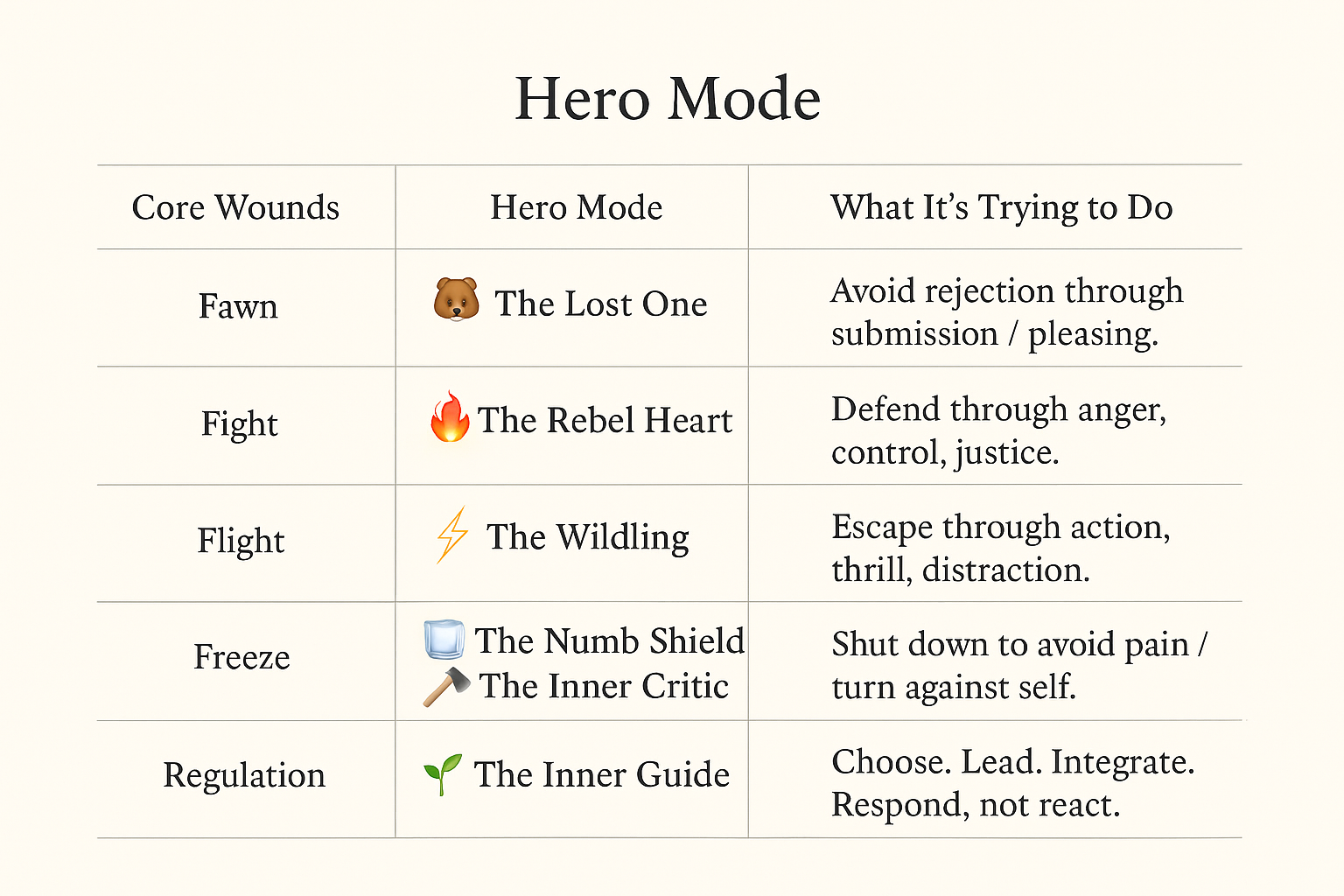
Core Hero Wounds
Core wounds are often rooted in childhood, these patterns shape our thoughts, feelings, and behaviours, persisting throughout our personal and professional lives. They lead us to repeat the same cycles and fall into toxic habits and relationships, commonly resulting in recurring spells of low mood and anxiety.
Wounds or patterns are essentially our negative beliefs about ourselves, others, and situations, deeply influencing our thoughts, feelings, and behaviours. They are the tricky emotional and behavioural habits we adopted early in life and continue to carry with us. Often rooted in childhood experiences where our emotional needs were unmet or we felt unsafe.
Core Hore Modes
Core wounds are often rooted in childhood, these patterns shape our thoughts, feelings, and behaviours, persisting throughout our personal and professional lives. They lead us to repeat the same cycles and fall into toxic habits and relationships, commonly resulting in recurring spells of low mood and anxiety.
Wounds or patterns are essentially our negative beliefs about ourselves, others, and situations, deeply influencing our thoughts, feelings, and behaviours. They are the tricky emotional and behavioural habits we adopted early in life and continue to carry with us. Often rooted in childhood experiences where our emotional needs were unmet or we felt unsafe.